


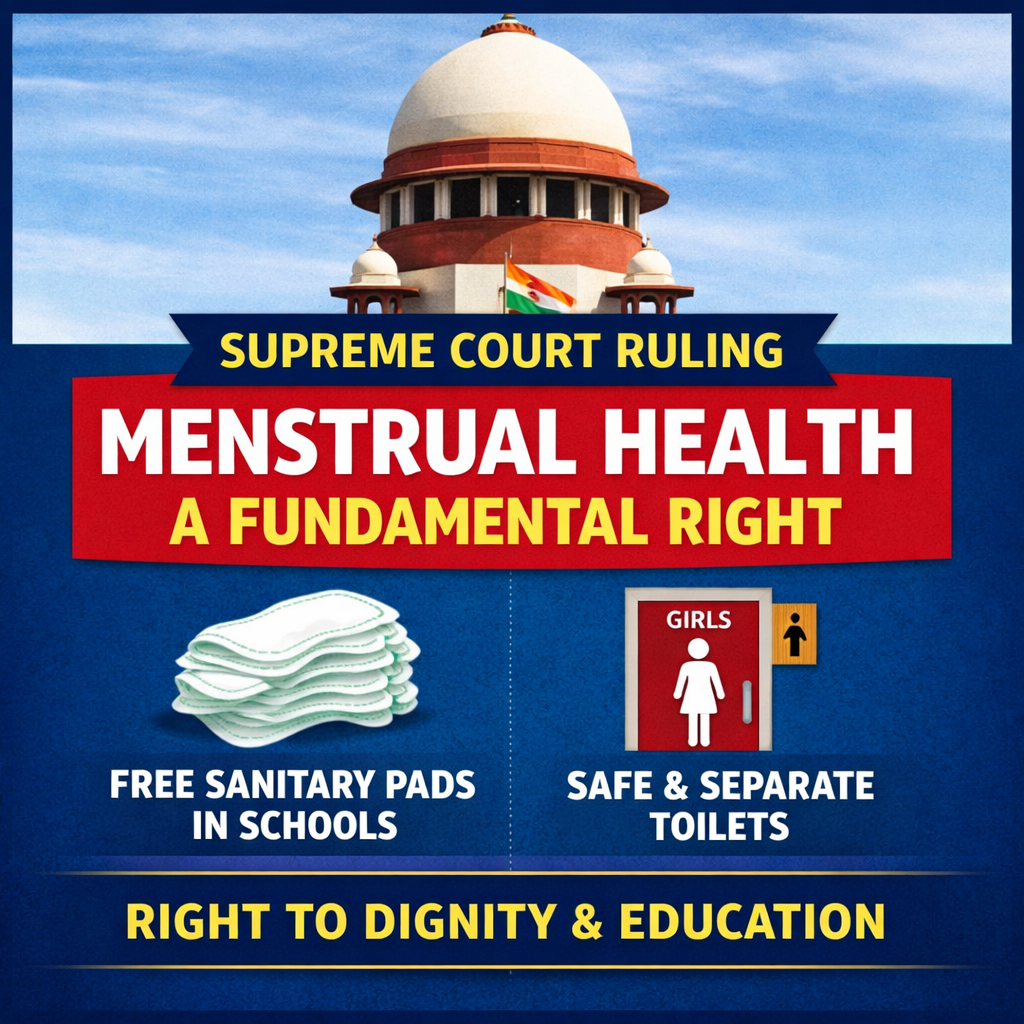
In a landmark judgment on January 30, 2026, the Supreme Court of India held that menstrual health is part of the right to life under Article 21 of the Constitution. This means access to safe menstrual hygiene is no longer just a policy goal — it is a constitutional right that every girl student in India must have.
What the Court Ordered
The top court issued clear directions that affect every school in the country:
1. Free Sanitary Pads for Schoolgirls
All schools — government, government-aided, and private — must provide biodegradable sanitary napkins free of cost to girls. These should be easily accessible, ideally through vending machines in the toilets or at a designated spot in the school.
2. Separate, Functional Toilets
Schools must have gender-segregated toilets with water, soap, and proper disposal facilities. These toilets must also be accessible for students with disabilities.
3. Menstrual Hygiene Management (MHM) Corners
Institutions should establish MHM corners stocked with essential items like spare uniforms, disposable bags, and other materials to help students manage menstruation with dignity.
4. Awareness and Sensitisation
The Court directed NCERT and SCERT to include menstrual health and puberty education in school curricula, and for teachers to be trained to support students effectively.
5. Strict Compliance and Accountability
If private schools fail to follow these directions, they risk de-recognition under the Right of Children to Free and Compulsory Education (RTE) Act. State governments will also be held accountable for ensuring compliance in public schools.
Why This Is Important
The Supreme Court found that lack of proper menstrual hygiene facilities — like sanitary pads and separate toilets — creates barriers to education for girls. When a girl misses school during her period due to lack of facilities, it affects her right to education, her dignity, and her future opportunities. By linking menstrual health to Article 21 (Right to Life) and the RTE Act, the Court recognised that dignity, equality, and education are all interconnected.
Legal Significance
This judgment is significant because:
- It expands the interpretation of Article 21 to include menstrual hygiene as part of the right to live with dignity.
- It reinforces the positive obligations of the state to remove barriers that prevent equal access to education.
- It uses constitutional principles — dignity, equality, and educational rights — to protect a health concern that disproportionately affects girls.
What Happens Next
States and Union Territories have been given a strict timeline to comply with the Court’s directions. Implementation will involve coordination between education and health departments, and regular monitoring to make sure schools actually provide the facilities ordered by the Court.