


The renewed momentum around the India–European Union Free Trade Agreement (FTA) marks a significant moment in India’s external trade and economic diplomacy. As highlighted in the recent Press Information Bureau (PIB) release, both sides have reiterated their commitment to pushing negotiations forward, signalling that the agreement is no longer just aspirational, but increasingly realistic.
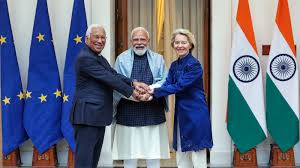
Negotiations for the India–EU FTA began as early as 2007, stalled in 2013, and were revived in 2022. The long pause was not accidental. It reflected deep disagreements over tariffs, intellectual property, data protection, labour standards, and regulatory autonomy. The fact that talks are now progressing again suggests a shift in priorities on both sides, shaped by changing global trade dynamics, geopolitical uncertainty, and the need for dependable economic partnerships.
Why the EU Matters to India
The European Union is among India’s largest trading partners, accounting for a substantial share of India’s exports and imports. According to official data referenced by PIB, bilateral trade has grown steadily in recent years, covering sectors such as engineering goods, pharmaceuticals, textiles, chemicals, services, and digital trade.
For Indian exporters, the EU market represents not just size, but stability and purchasing power. However, high tariffs, technical standards, and regulatory barriers have historically limited market access. The FTA aims to address precisely these friction points.
What the Agreement Seeks to Achieve
At its core, the India–EU FTA seeks to liberalise trade in goods and services while setting predictable legal rules for investment and commercial engagement. The PIB release notes that the EU has offered significant tariff concessions, with a large percentage of tariff lines proposed to be eliminated either immediately or in a phased manner. India, in turn, has offered market access across a broad range of tariff lines while retaining safeguards for sensitive domestic sectors.
Beyond tariffs, the agreement places strong emphasis on services, an area where India holds a comparative advantage. Sectors such as IT and IT-enabled services, professional services, financial services, and education are expected to see improved market access. Provisions on the movement of professionals are particularly relevant for Indian service providers seeking short-term entry into EU markets.
Legal and Regulatory Implications
From a legal standpoint, the FTA is far more than a commercial arrangement. It will require careful alignment between domestic laws and international commitments. Issues such as intellectual property rights, data governance, competition law, public procurement, and sustainable development obligations are central to the negotiations.
The EU traditionally insists on higher regulatory standards, particularly in areas such as environmental protection and labour rights. For India, the challenge lies in accommodating these standards without compromising constitutional principles, policy flexibility, or the interests of domestic industries and small enterprises.
This makes the agreement especially important for lawyers, policymakers, and courts, as future disputes, compliance questions, and interpretative challenges are likely to arise once the FTA comes into force.
The Legal Lens: Courts, Compliance, and Constitutional Balance
From a legal perspective, the India–EU FTA is likely to have a lasting impact on how Indian courts, regulators, and policymakers interpret trade-related obligations. Once in force, the agreement will not remain confined to diplomatic circles; it will influence domestic legislation, administrative decision-making, and judicial interpretation. Questions relating to the enforcement of intellectual property rights, data protection standards, environmental compliance, and market access commitments may increasingly reach Indian courts and tribunals. Judges may be called upon to balance international trade commitments with constitutional principles such as sovereignty, equality before law, and the right to carry on trade under Article 19(1)(g). At the same time, regulators will have to ensure that domestic rules align with FTA obligations without diluting public interest protections. In this sense, the India–EU FTA is not just a trade instrument, but a legal framework that will shape future litigation, regulatory governance, and India’s evolving trade jurisprudence.
Strategic Significance Beyond Trade
What makes the India–EU FTA particularly significant is its strategic dimension. In a world marked by supply chain disruptions, trade wars, and geopolitical realignments, both India and the EU are seeking reliable partners. The FTA is as much about trust and long-term cooperation as it is about trade figures.
For India, the agreement supports its broader goal of integrating with global value chains while positioning itself as a credible alternative manufacturing and services hub. For the EU, it strengthens engagement with a major Indo-Pacific partner at a time when economic diplomacy is increasingly intertwined with strategic interests.
The Road Ahead
While the PIB release reflects optimism, the agreement is still subject to final negotiations, legal scrubbing, and ratification processes on both sides. In the EU, this involves approval by the European Parliament and member states. In India, domestic approval mechanisms will come into play.
Once concluded, the India–EU FTA is likely to shape India’s trade policy for years to come, influence domestic regulatory frameworks, and open new avenues for businesses, professionals, and investors. It also sets a benchmark for how India approaches future trade agreements with other major economies.
In many ways, the India–EU FTA represents a reset, not just of trade relations, but of how India positions itself in the global economic order—confident, cautious, and increasingly central.