


For as long as most of us can remember, owning a flat in Mumbai has meant living with a quiet legal fiction. You pay in crores. You register the sale. You frame the sale deed and hang it somewhere respectable. And yet, if you pulled up the government’s actual land record for the plot your building stands on, your name wouldn’t be on it. The builder’s would and you’d be, in the eyes of the state’s revenue department, a resident of land you technically don’t own.
Maharashtra has just decided that fiction has run its course.

The problem, in one image
Picture a 7/12 extract: the Satbara Utara, the document that has decided who owns what patch of land in this state for generations. It was built for a flatter world: one owner, one plot, one entry. It works beautifully for a farmhouse in Nashik. It collapses the moment you try to use it for a forty-storey tower in Lower Parel with three hundred flats stacked on a single plot. The extract simply wasn’t designed to hold three hundred owners on one piece of land, each entitled to a sliver of it.
So the record stayed silent about the sliver. The builder or the housing society sat at the top as the recognised landowner, and everyone above the ground floor existed in the record as a kind of legal afterthought- protected by their sale deed, yes, but invisible to the land registry itself. That invisibility had real teeth. It slowed down redevelopment negotiations, complicated inheritance, made banks twitchy about loan collateral, and left the door open to the oldest trick in Indian real estate: selling the same flat to two people, because nothing at the land-record level said otherwise.
Enter the Vertical Property Card
The Vertical Property Card (VPC) is the state’s fix, and it does something conceptually simple: it takes the idea of land ownership and tilts it ninety degrees.
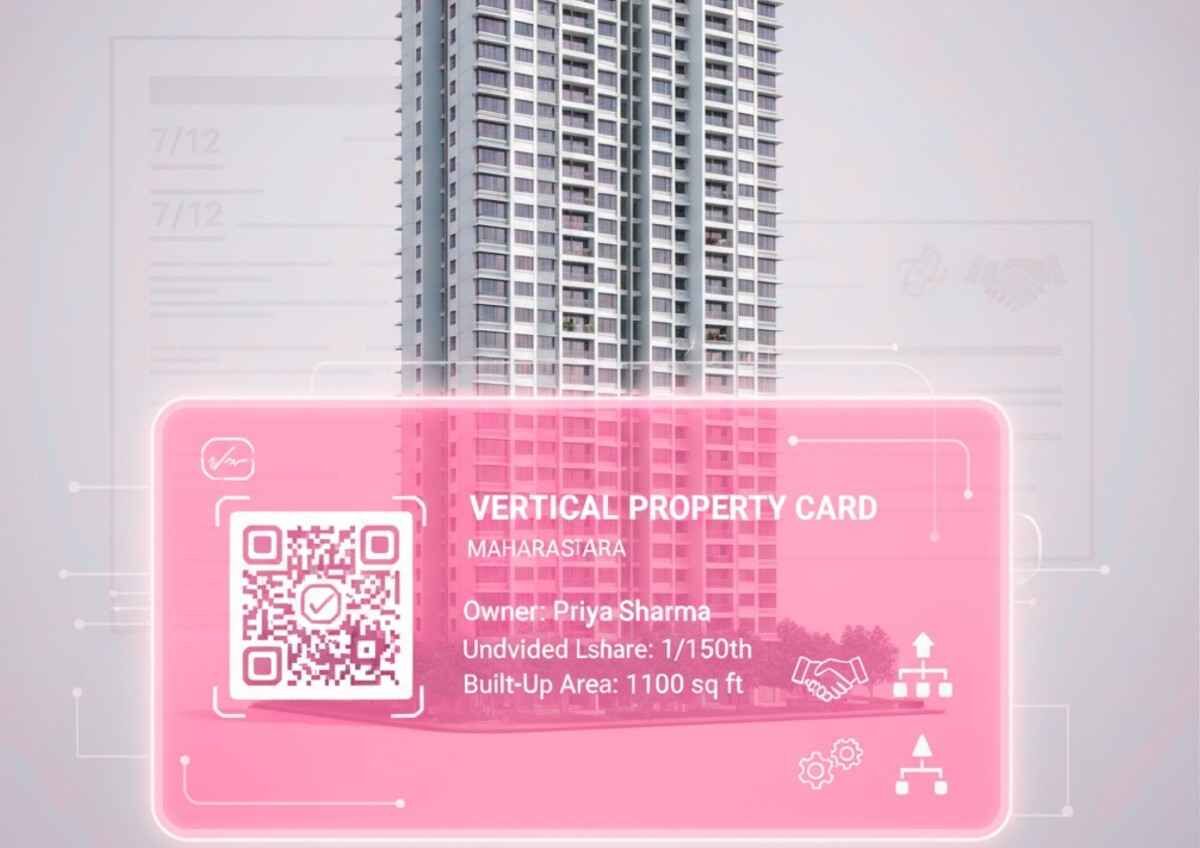
Where a traditional Property Card records land horizontally, this plot, this owner, the VPC records it vertically, allowing a single plot to carry dozens or hundreds of individual ownership entries, one per flat, each with its own defined land share. If your flat is 800 square feet in a building with a total carpet area of 10,000 square feet, your card will state, in black and white, your proportional claim on the land beneath, something in the range of 99 square feet of land, expressed either as a fraction (say, 1/150th) or as an exact figure.
This isn’t cosmetic. It changes what the government’s own registry says about you. Under the reform, flat owners’ names will now appear in the 7/12 extract itself, a record historically associated with agricultural and rural land, with entries structured around a gat number and a defined ownership share. For the first time, a flat on the eighth floor gets to exist in the same legal universe as a farm in Raigad.
What sits inside the card
A few features make the VPC more than a symbolic gesture:
- Ownership details: your name, flat number, floor, and carpet area
- The land share: the specific, calculated proportion of the plot attributable to your flat
- Encumbrances: any loan or charge against the property, so the card doubles as a live financial fingerprint of the flat
- A QR-coded digital signature: meant to make the document tamper-resistant, closing the door on the kind of forged paperwork that has fuelled property fraud for decades
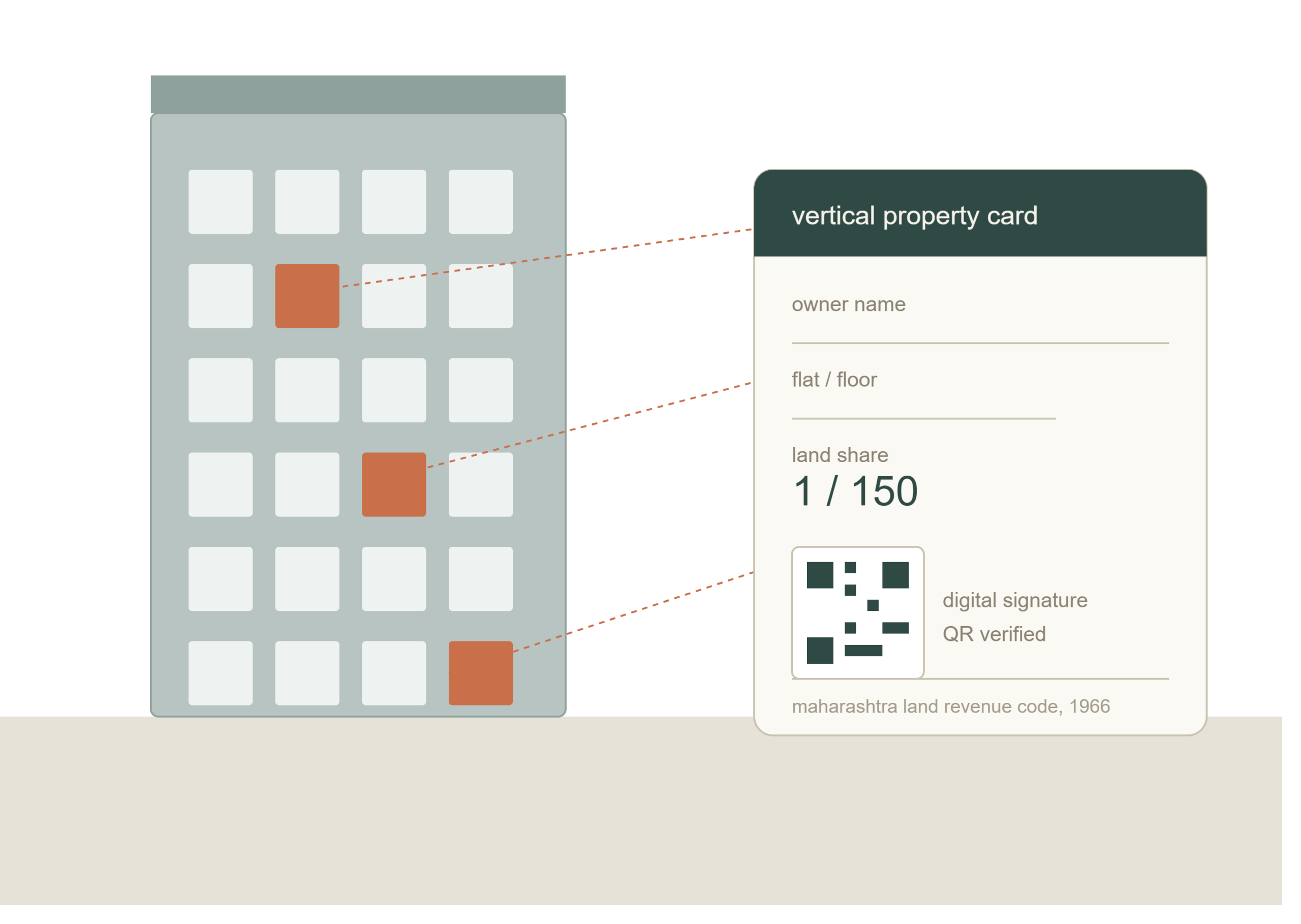
Crucially, the VPC doesn’t replace your sale deed or your share certificate from the cooperative housing society. Those remain your primary proof of purchase. What the card does is far narrower and, in a way, more foundational: it stitches your existing ownership into the state’s land registry, the document that courts, banks, and revenue officers actually treat as the ground truth.
The legal architecture behind it
This isn’t a circular or a notification quietly slipped out — it involves amending the Maharashtra Land Revenue Code, 1966, the statute that governs how land records are maintained in the state. An eight-member committee has been tasked with drafting the formal Vertical Property Rules under this amendment, which is the kind of detail that tells you this reform is meant to have teeth, not just good intentions.
For cooperative housing societies, the VPC layers onto an existing legal structure rather than disrupting it. Under the Maharashtra Cooperative Societies Act, 1960, members already hold an implied equal share in the society’s land, the VPC simply converts that implied share into a numbered, documented, individually held right. Redevelopment votes, majority requirements, and the society’s internal governance stay exactly as they were.
There’s also a leasehold wrinkle worth knowing. In places like Navi Mumbai, where large tracts sit on CIDCO-allotted land under 60- or 99-year leases, the VPC records your ownership within that lease structure, it doesn’t quietly convert leasehold into freehold, so don’t expect it to solve that particular headache.
Who gets one, and when
The rollout is staggered, and the dates matter if you’re advising a client or tracking your own paperwork:
New flats: From January 1, 2026, every flat registered under a MahaRERA-registered project receives a VPC automatically, as part of the standard registration package. The builder initiates it with no separate application needed.
Existing flats: Owners in buildings that predate this system have a window to apply through their housing society, at a fee of ₹500 per flat, until December 2027. The government has also waived the roughly ₹8,000 measurement cost per property under a parallel initiative, which is a meaningful concession for societies operating on thin budgets.
Miss the December 2027 deadline, and you’re not stripped of your flat but you stay outside a record system that is quickly becoming the default language banks, buyers, and revenue officers speak to each other in.
Why is this important
It’s tempting to file this under bureaucratic housekeeping. It isn’t. Land title in India has always been a strange, layered thing: presumptive rather than guaranteed, built on a stack of sale deeds and registration entries rather than one clean, government-certified truth. The VPC doesn’t fix that problem for India. But for apartment owners in Maharashtra specifically, it closes one of the more absurd gaps in that stack: the fact that you could hold full legal title to your home and still be a ghost in the land record beneath it.
If it works: if the mapping is accurate, if societies actually apply before the 2027 deadline, if the QR-coded verification holds up against India’s long, inventive history of paper fraud, Maharashtra will have quietly solved a problem most other Indian states haven’t even acknowledged yet. Given how many people in this country now live stacked on top of each other rather than beside each other, that’s not a small thing.