


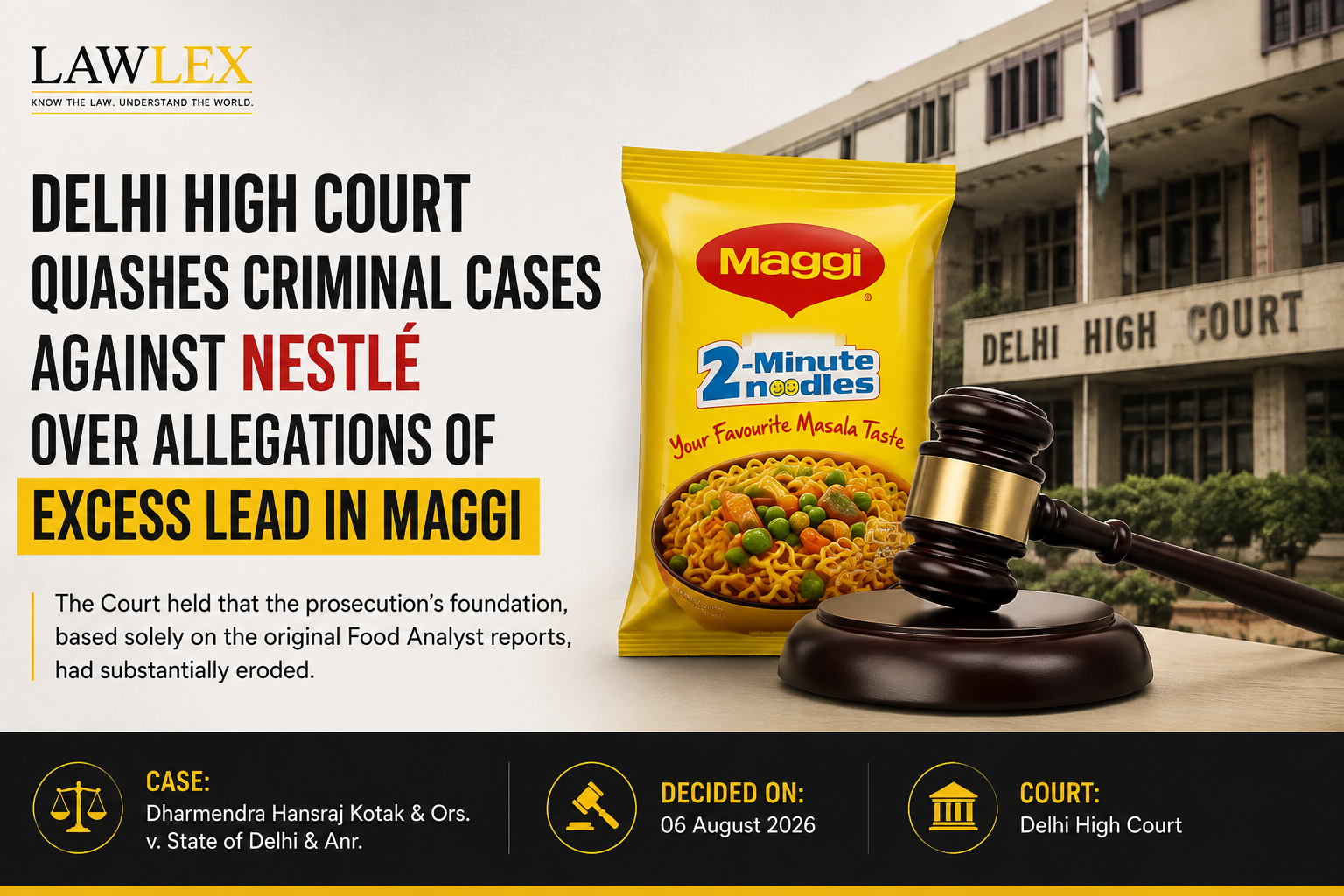
Nearly 11 years after the 2015 Maggi controversy, the Delhi High Court has brought two criminal prosecutions arising from the episode to an end.
In Dharmendra Hansraj Kotak & Ors. v. State of Delhi & Anr., Justice Madhu Jain quashed the criminal complaints, summoning orders and all consequential proceedings against the petitioners, including persons connected with the distribution and manufacture of Maggi noodles.
What was the case about?
In May 2015, Food Safety Officers in Delhi collected Maggi samples from retail outlets as part of the nationwide sampling exercise.
The Food Analyst’s reports dated June 2, 2015 declared the samples unsafe, stating that the lead content in the masala tastemaker exceeded the permissible limit of 2.5 ppm. One of the complaints also alleged misbranding on account of the label declaration “No Added MSG.”
Based on these reports, criminal complaints were filed under Sections 20, 26 and 27 of the Food Safety and Standards Act, 2006, punishable under Section 59.
The prosecution’s case, therefore, stood largely on the original Food Analyst reports.
What changed?
The controversy subsequently went through multiple rounds of judicial scrutiny.
The Bombay High Court, in Nestle India Ltd. v. FSSAI, found serious legal infirmities concerning the laboratories whose reports formed the basis of the regulatory action and directed fresh testing through laboratories satisfying the statutory requirements of accreditation and notification.
The Supreme Court subsequently directed testing by CSIR-CFTRI, Mysore, a Referral Food Laboratory under the FSS Act. The Court specifically directed examination of lead and glutamic acid levels and clarification regarding MSG. The CFTRI reports found the relevant parameters within the permissible limits. The Supreme Court later directed that the CFTRI report form the basis for adjudication before the NCDRC.
Why did the Delhi High Court intervene?
The petitioners approached the Delhi High Court under Section 482 CrPC, invoking the Court’s inherent powers to prevent abuse of the process of law.
The State argued that the Delhi prosecutions were independent proceedings based on samples separately collected in Delhi. It also contended that the accused had failed to exercise their statutory right to seek referral analysis at the relevant time.
The Court, however, found that the prosecution did not rely on any independent evidence of adulteration beyond the original Food Analyst reports.
Once those reports had been subjected to judicial scrutiny and fresh scientific testing had been undertaken through a statutory Referral Food Laboratory under the supervision of the Supreme Court, the Court held that the evidentiary value of the earlier reports had “substantially eroded.”
The Court stressed that although criminal proceedings ordinarily operate independently, it could not ignore subsequent developments when the very scientific foundation of the prosecution had undergone authoritative re-examination.
It also relied on similar decisions of the Himachal Pradesh and Uttarakhand High Courts concerning prosecutions arising from the same Maggi controversy.
The Court’s conclusion
The Delhi High Court held that allowing the prosecutions to continue would serve no useful purpose and would merely force the petitioners into a protracted criminal trial despite the substantial erosion of the prosecution’s foundation.
It therefore exercised its inherent jurisdiction under Section 482 CrPC and quashed the complaints, the summoning orders dated November 6, 2015 and January 11, 2016, and all consequential proceedings.
The legal takeaway:
The judgment is significant not because the High Court conducted a fresh trial on whether Maggi contained excessive lead, but because it examined whether a criminal prosecution can continue when the sole evidentiary basis for that prosecution has been substantially undermined by subsequent judicially supervised scientific testing.
It is a useful illustration of how scientific evidence, regulatory procedure and the High Court’s inherent jurisdiction under Section 482 CrPC can intersect in food-safety prosecutions.
Case: Dharmendra Hansraj Kotak & Ors. v. State of Delhi & Anr., CRL.M.C. 7013/2022 & CRL.M.C. 328/2023, decided on August 6, 2026.