


Justice in the Blue House: The Historic Sentence of Kim Keon Hee

On April 28, 2026, the Seoul High Court gave a judgment that changed the legacy of former President Yoon Suk Yeol’s government. Former First Lady Kim Keon Hee was sentenced to four years in prison, which was more than double her earlier 20-month sentence. This was not just a court decision, but a strong symbol of accountability. It marked the end of an era often criticised for corruption, misuse of influence, and the mixing of public office with private benefit.
1. The Stock Manipulation Case
The most important part of the ruling was the court’s decision to reverse an earlier acquittal in the Deutsch Motors stock manipulation case.
Between 2010 and 2012, several people were accused of illegally raising the share prices of Deutsch Motors, a BMW dealer, by almost 400%. A lower court had earlier said Kim was not directly involved, but the Seoul High Court found enough evidence to treat her as an active participant in the plan.
The court said Kim handed over around 2 billion won (about $1.4 million) through securities accounts to Blackpearl Invest, the group leading the manipulation. More importantly, the judges found proof of an agreement where she would receive 40% of the profits. The court said this was not normal investment behavior, but part of a planned illegal arrangement.
Judge Shin Jong-oh also noted that Kim made trades at the exact time and prices told to her by the main accused, Kwon Oh-soo. This showed active involvement, not simple coincidence or investment luck.
2. The Bribery Case
The court also took strict action against the luxury gifts she received from the Unification Church.
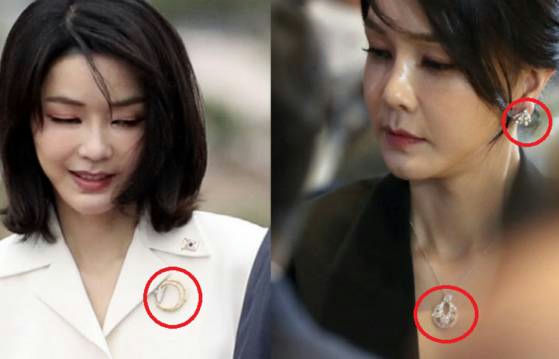
Two expensive luxury bags became a major part of the case. One was received in July 2022, after the presidential inauguration, and another in April 2022, when Yoon was still President-elect. The appeals court rejected the earlier claim that the April gift was just a congratulatory present. It ruled that a luxury bag worth 8 million won could not be treated as an innocent gift.
A high-value Graff necklace was also treated as a bribe. The court ordered it to be confiscated, making it clear that such expensive items were not personal gifts but illegal benefits linked to political influence.
3. The Court’s Strong Warning
The judges were unusually direct during sentencing. They said that the First Lady holds a position that represents the nation and therefore must follow a much higher standard of honesty and responsibility.
The court stated that Kim used her position to commit crimes, damaged government transparency, and broke public trust. It also said her actions created serious national division and political conflict.
By accepting what the court called a “comprehensive quid pro quo,” it believed she knew that the Unification Church wanted government support for its overseas activities and accepted the gifts with that understanding.
4. The Bigger Political Collapse
This trial is part of a much wider political crisis that followed the December 2024 martial law controversy in South Korea.
Former President Yoon Suk Yeol’s government collapsed after his attempt to suspend civilian rule led to impeachment and major legal consequences.
Yoon himself is now serving a life sentence for leading an insurrection. The former Prime Minister has also been sentenced to 23 years in prison.

This has left the current administration under President Lee Jae-myung dealing with the aftermath of one of the biggest political breakdowns in recent South Korean history, where many top officials of the previous government are either jailed or facing trial.
5. What Happens Next
Kim Keon Hee appeared in court wearing glasses and a mask and remained mostly silent as the sentence was announced.
Her legal team said they respect the court, but argued that the ruling came because of political pressure on an administration that has already lost power.
They have now officially appealed to the Supreme Court of Korea. Since the Supreme Court mainly looks at legal errors rather than fresh evidence, the defense will likely focus on challenging the court’s decision to call her a “co-principal” in the stock manipulation case.
Until then, Kim remains in detention. A powerful reminder of how quickly political power can fall, and how even those at the top of the Blue House are not beyond the reach of law.