


The SHANTI Bill has now become law in India!
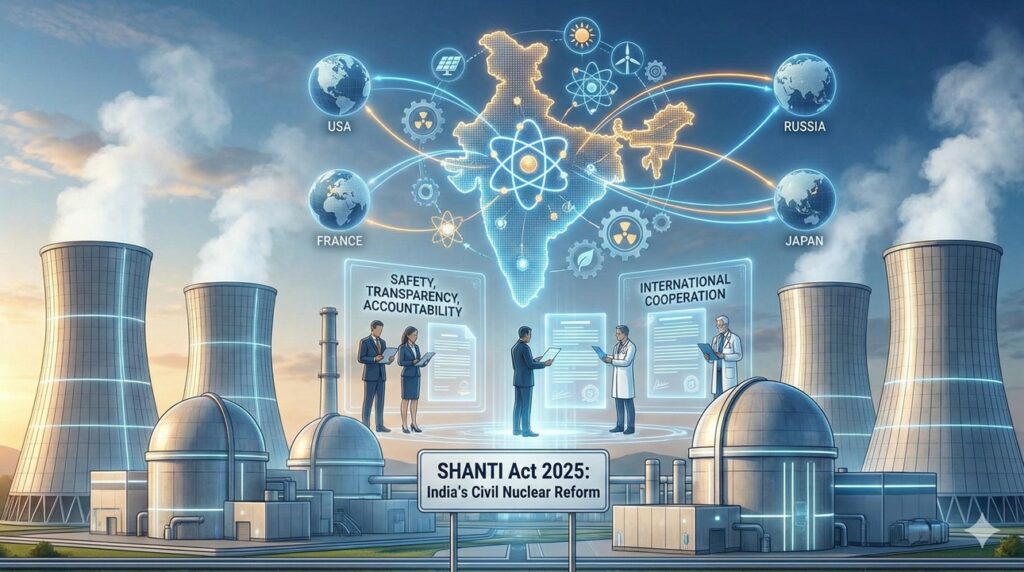
The Sustainable Harnessing and Advancement of Nuclear Energy for Transforming India (SHANTI) Bill, 2025, was passed by both houses of Parliament during the recent Winter Session and then received the presidential assent on 20 December 2025, which is the final step for a bill to become law. In this article, we will look at the key changes introduced by this new law.
Background
Primarily, it represents the most significant reform in India’s nuclear energy policy since independence because it ends the exclusive government monopoly over civil nuclear power generation and allows private participation with certain regulations. But you might think, why was nuclear power closed to private players? The reason being nuclear energy in India has been historically treated as a strategic sector due to national security concerns, international non-proliferation obligations and safety risks.
However, not so surprisingly, this model limited the access to advanced technology and led to slow capacity addition which in turned somewhere backfired us due to heavy dependence on public finances.
Hence, this act not only enables private and joint venture participation of both Indian and foreign companies, (subject to licensing), but also amends existing nuclear laws- the Atomic Energy Act, 1962 and Civil Liability for Nuclear Damage Act, 2010.
What Triggered Introduction of SHANTI
First and foremost, India has 2 ambitious aims- one achieving net-zero emission by 2070, and another achieving 100 GW nuclear capacity by 2047 (current capacity is around 8 GW). We are aware that renewable energy like solar and wind are intermittent but nuclear energy provides stable baseload power along with zero-carbon electricity, hence making it of immense importance. When global participation comes in, it brings along project efficiency, cost management and new innovation like Small Modular Reactors which can be installed in 3-5 years, instead of traditional 10-15 years of on-site work.
Detailed View of The Changes
1. Opening the Nuclear Sector to Private Companies
As already mentioned above, one of the most significant shifts introduced by the SHANTI Act is the partial opening of India’s nuclear energy sector to private participation which has remained almost entirely under state control, through the Nuclear Power Corporation of India Limited (NPCIL).
The Act allows private entities to participate in non-strategic aspects of nuclear energy, such as reactor construction, fuel cycle services, technology development, and maintenance operations, under strict regulatory supervision. However, ownership of nuclear material and overall strategic control continues to remain with the State.
2. Amendment to the Atomic Energy Act, 1962
To enable private participation, the SHANTI Act introduces targeted amendments to the Atomic Energy Act, 1962, which grants the Central Government exclusive authority over nuclear energy activities.
The amendments dilute the absolute monopoly of the State and amends certain provisions that restrict participation only to government-owned entities. While core functions relating to nuclear materials, weapons, and national security remain untouched, the amendments create legal space for licensed private operators to engage in nuclear power projects.
3. Reforms to Nuclear Liability Framework
The Act continues to place strict liability on the operator of a nuclear installation, ensuring that victims are not required to pursue multiple parties in case of a nuclear incident. At the same time, it limits the operator’s right of recourse against suppliers by limiting supplier liability to situations expressly stated in contractual agreements or in cases of wilful misconduct defects.
This marks a shift from the earlier framework, where suppliers faced broader liability risks. The Act also reinforces a statutory cap on the operator’s liability. By capping liability and clarifying responsibility, the reform seeks to balance victim compensation with the need to create an investment-friendly environment for private and foreign participation in India’s nuclear sector.
4. Institutional and Regulatory Reforms
The SHANTI Bill also proposes institutional restructuring to strengthen governance and oversight. It emphasises enhancing the autonomy and capacity of regulatory bodies responsible for nuclear safety, licensing, and compliance.
It provides statutory status to the nuclear regulator body- AERB- Atomic Energy Regulatory Board- making it answerable to the Parliament of India. It also proposes creation of a dedicated atomic disputes tribunal and facilitation of advanced nuclear technologies.
Pros
-
Encourages investment and participation
By capping liability and clarifying who is responsible, private and foreign companies are more likely to invest in India’s nuclear sector without fear of legal risk. -
Faster expansion of nuclear energy
With clearer rules and reduced uncertainty, projects can move faster, helping India meet its clean energy and power demands. -
Clear responsibility in case of accidents
Keeping primary liability with the operator avoids confusion during a nuclear incident and ensures victims know who is accountable.
Criticisms
-
Reduced pressure on suppliers
Limiting supplier liability may reduce incentives for suppliers to maintain the highest safety standards, as their legal exposure is narrower. -
Risk of inadequate compensation
When liability caps are too low, compensation usually falls short in the event of a major nuclear accident, leaving the government to step in. -
Public trust concerns
Diluting liability rules can create fear and skepticism among the public, especially given the high-risk nature of nuclear energy.
Conclusion
By easing entry for private players and restructuring liability norms, the SHANTI Act aims to push India towards a cleaner and more secure energy future. However, nuclear energy carries risks that cannot be treated like ordinary commercial startups. Ensuring strict regulation, transparent oversight, and fair compensation will be highly essential to prevent economic growth from coming at the cost of public safety.
What are your thoughts? Tell us in the comment section below.