


Background
On April 20, 2026, the Punjab government led by Chief Minister Bhagwant Mann formally notified the Jaagat Jot Sri Guru Granth Sahib Satkar (Amendment) Act, 2026, replacing the older 2008 Satkar Act.
The bill had been unanimously passed by the Punjab Assembly on April 13, a special session convened on the occasion of Baisakhi, and was then sent to the Governor.
After Governor Gulab Chand Kataria gave his assent, the bill was formally enacted, allowing the state to implement its provisions with immediate effect.

What the law actually says
The law amends the existing 2008 Act governing the sanctity of the Guru Granth Sahib, and its provisions have significant teeth.
Definition of sacrilege: The Act defines sacrilege as
“any wilful and deliberate act, committed with the intent of desecration by way of physical damaging, defacing, burning, tearing or theft of the Saroop(s) of Sri Guru Granth Sahib or part thereof, or by words, either spoken or written, or by signs or by visible representations or through electronic means or otherwise, which is of such a nature as to hurt the religious feelings of persons professing the Sikh faith.”
Notably, this brings social media posts and AI-generated content within the law’s ambit.
Punishments: Any person convicted of sacrilege faces imprisonment of not less than seven years, extendable to 20 years, plus a fine of ₹2 lakh to ₹10 lakh.
Where the offence involves criminal conspiracy intended to disrupt peace or communal harmony, the minimum sentence rises to ten years, extendable to life imprisonment, with a fine of ₹5 lakh to ₹25 lakh.
Confiscation of the convict’s property is also provided for in all cases of conviction.
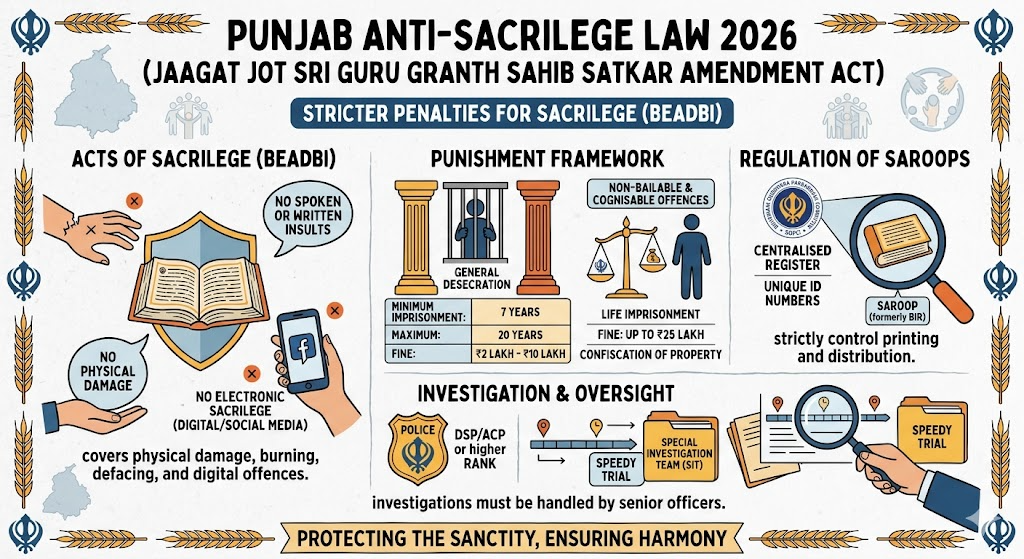
Procedural safeguards: Offences under the law are non-compoundable and cases cannot be settled outside court.
Only a police officer of DSP rank or above can investigate such cases, and trials are conducted in sessions courts.
Administrative provisions: The law assigns the Shiromani Gurdwara Parbandhak Committee (SGPC) the duty of maintaining a Central Register recording the printing, storage, distribution, and supply of each Saroop, including a unique identification number for every copy.
Custodians are required to ensure safe custody, observe the Sikh Rehat Maryada, and immediately report any incident of damage or suspected sacrilege to authorities.
The legal strategy: why this succeeded where others failed
Punjab has attempted, at least three times in the past decade, to enact stricter anti-sacrilege provisions by amending central criminal law.
The 2016 amendment brought by the SAD-BJP government and the 2018 version under Congress both sought to introduce life imprisonment for sacrilege through changes to the Indian Penal Code. Both efforts failed , where one was returned by the President after being termed “excessive in law,” while the other remained undecided for years before effectively lapsing.
Chief Minister Mann clarified that since the legislation amends an existing state law, it does not require Presidential assent and falls squarely within the state’s legislative competence.
This is the critical legal manoeuvre: by amending the 2008 Jaagat Jot Sri Guru Granth Sahib Satkar Act, a state-level law, rather than seeking to modify central statutes like the IPC or BNS, the AAP government did not need the Presidential assent requirement that had blocked all previous attempts.
Why introduce it when older laws exist?
The government’s argument: An official spokesperson stated that sections 298, 299, and 300 of the Bharatiya Nyaya Sanhita, 2023 already address religious offences, but do not carry penalties considered stringent enough in the context of sacrilege. The Cabinet noted that the bill aims to address this gap by introducing stricter punishment, providing clarity in legal definitions, and ensuring that the law applies across faiths.
The Mann government also argues that previous laws were not sufficient to address the seriousness of sacrilege. By imposing life imprisonment and widening the definition of the offence, the new law aims to establish both deterrence and symbolic recognition, signalling that the state acknowledges the unique status of the Guru Granth Sahib as a living Guru within Sikhism, not merely a holy book.
The critics’ counter: Section 295A of the Indian Penal Code, now retained in substantially identical form under the Bharatiya Nyaya Sanhita, already penalises deliberate and malicious acts intended to outrage religious feelings.
It applies across all religions and has been on the books since 1927. The sacrilege of a sacred scripture is already cognisable under this provision. The Punjab government has not explained on this.
The proportionality problem
The punishment prescribed under the amended Act exposes the fundamental disproportionality.
A minimum of seven years for sacrilege, rising to twenty years and potentially life imprisonment, places this offence in the same bracket as rape under the BNS, and above the minimum punishment prescribed for terrorist acts under Section 15 of the Unlawful Activities Prevention Act (UAPA), where the floor is five years and the ceiling is life imprisonment.
Dacoity with murder under the IPC carries a similar sentencing range.
Concerns
The proof problem: Sacrilege, by its nature, is often discovered after the fact. A damaged Saroop, a torn page, a defaced scripture these are acts that typically leave no direct witness, no CCTV footage, no digital trail. In such a shortage of evidence, the temptation to blame the nearest convenient target that can be a member of a minority community, an ideological opponent, a personal rival, is possible.
Risk of misuse: Punjab’s police has a long and well-documented history of deploying legal provisions selectively and coercively. A law that allows cognisable, non-bailable arrest for an offence that is difficult to prove and easy to allege with no prior sanction requirement hands police force an instrument whose potential for misuse is enormous.
Constitutional tensions: The law’s expansive definition of sacrilege covering speech, writing, and electronic communication sits in potential tension with Article 19, which guarantees freedom of speech and expression, and Article 25, which protects freedom of conscience and free profession, practice, and propagation of religion.
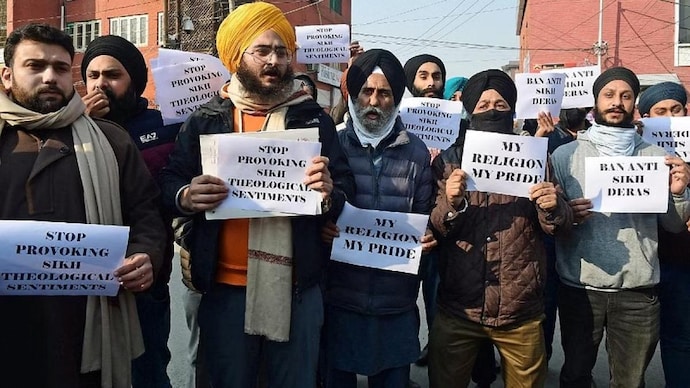
The Akal Takht’s objection: Several speakers at a meeting called by the Jathedar of the Akal Takht expressed that the Act amounts to direct interference in Sikh religious affairs. The Akal Takht disapproved of the amendment and called the Punjab Assembly Speaker for detailed discussions on May 8.

The mob violence context
Punjab has witnessed, in recent years, a deeply troubling phenomenon: extrajudicial killings and mob violence carried out in the name of punishing acts of sacrilege.
Individuals accused sometimes on nothing more than rumour or suspicion of desecrating the Guru Granth Sahib have been lynched or killed before any court has had the opportunity to examine the evidence. In many of these cases, the state machinery was slow to act, and perpetrators of such vigilante violence faced little meaningful accountability.
This law, rather than directly addressing that vigilante culture, deepens the criminality of the underlying act, which critics say does nothing to reduce mob justice.
The bottom line
Punjab’s Jaagat Jot Sri Guru Granth Sahib Satkar (Amendment) Act, 2026 is the culmination of a decade of political frustration, grief over the 2015 Bargari incidents, and three failed legislative attempts.
Whether it becomes a genuine deterrent or an instrument of political and communal pressure will depend entirely on how Punjab’s courts and police choose to use it.