


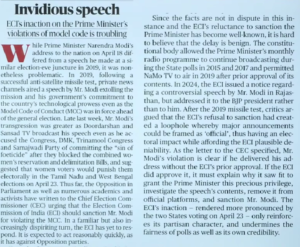
 In the context of an article published in The Hindu newspaper, titled ‘Invidious Speech‘, on 22nd April 2026.
The Model Code of Conduct was born from an agreement in 1960, a set of norms designed to ensure a level playing field. However, as the latest controversies regarding the Prime Minister’s broadcasts and political rhetoric suggest, these rules are struggling against the tide of modern political strategy and controlled media.
1. The loophole of the official
The article points out how “official” broadcasts (like those on Doordarshan or Sansad TV) can be used for electoral gain under the guise of government duty.
The current MCC is vague on what constitutes an “unavoidable official duty” versus an “electoral appeal” when delivered by a sitting head of government.
Therefore, we need a “Blackout Protocol” for state-owned media. During the MCC period, any address by a constitutional authority—unless it concerns a national emergency or a non-partisan statutory requirement—should require mandatory pre-clearance by a multi-party ECI committee.
2. Accountability at the top
The ECI recently issued notices regarding the PM’s speeches to the party president rather than the individual. This creates a buffer that shields top leadership from direct accountability.
Legal scholars often refer to this as the “Doctrine of Personal Responsibility.” In electoral law, the agency of the speaker is paramount.
Hence, The MCC should be amended to state that violations involving hate speech or “invidious speech” (as the article calls it) must be served directly to the candidate, regardless of their rank. This prevents the institutionalization of blame where the party takes a slap on the wrist while the individual reaps the electoral reward.
3. The essence of time
There is a long-standing debate: Should the MCC be made a law (statutory)?
While making the MCC a law would allow for faster judicial intervention, it might also lead to endless litigation that obstructs elections. We should introduce “Time-Bound Adjudication.” If a complaint is filed against a high-ranking official, the ECI must, by law, pass a reasoned order within 48 hours. Silence or “reluctance to sanction” should be legally treated as a failure of constitutional duty, subject to immediate High Court or Supreme Court review.
Conclusion
From a jurisprudential lens, the ECI’s inaction doesn’t just affect one election; it creates a precedent of impunity. When one player is allowed to bypass the rules because they are too big to penalize, it creates a negative effect on the opposition’s ability to compete.
In the words of the late Justice H.R. Khanna, “The democratic process can only function if the people have faith in the integrity of the elections.”
If the ECI continues to allow deniability for those in power, it risks transitioning from an active watchdog to a silent spectator.