


Introduction-
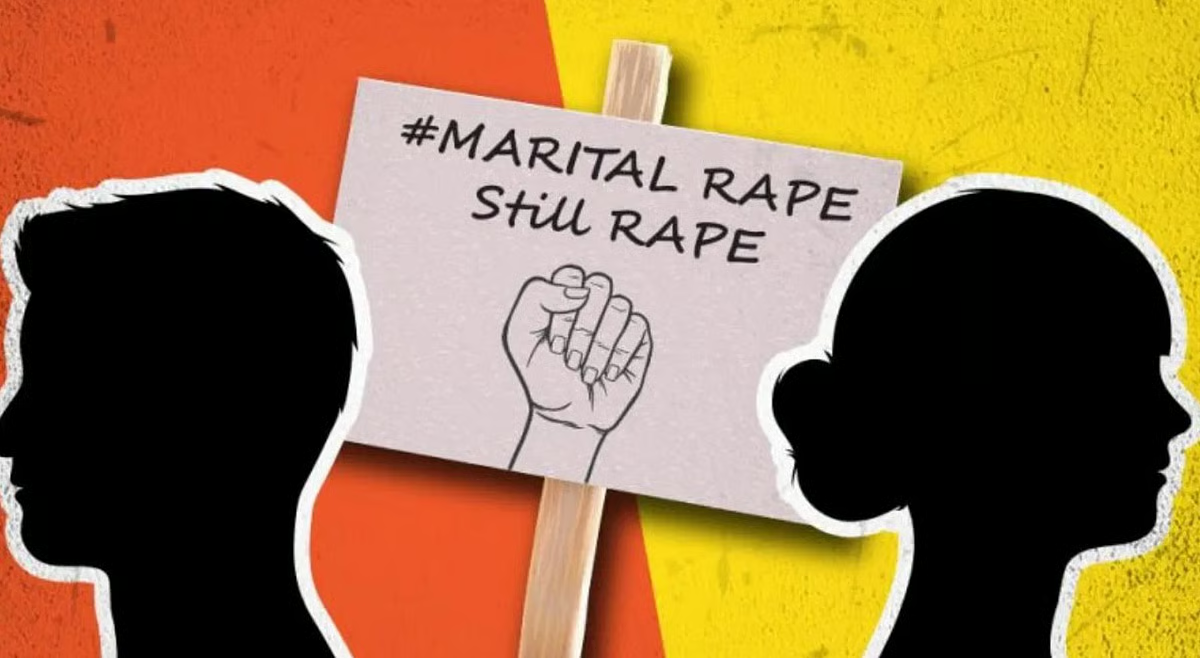
The word “rape” comes from the term “rapio”, which means to seize. Rape is, therefore, the forcible seizure of a woman without her consent, by force, fear, or fraud. When one mentions rape, it is mostly assumed to be done by some stranger or malicious person. It is not usually thought of in the context of marriage. Marital rape remains one of the most debated yet ignored forms of sexual violence in India. Despite several judicial pronouncements expanding the right to dignity and bodily autonomy under Article 21, the IPC still exempts husbands from being prosecuted for raping their wives.
Marital rape is a serious problem that millions of women worldwide have to suffer and face such abuse on a day-to-day basis. It is difficult to obtain accurate data on rape and violence against women within the family, as women raped by their husbands may hesitate to report because of family loyalty, fear of their abuser’s retribution, inability to leave the relationship, safeguarding the future of their children, or the fact that there are no stringent laws in force protecting the victims of marital rape.
Hence, the question is no longer whether marital rape exists, but whether India will finally acknowledge it as a crime.
Historical background-
The marital rape exemption stems from Victorian-era British law, which treated a wife as her husband’s property. Exception 2 to Section 375 IPC reflects this outdated notion, stating that sexual intercourse by a man with his own wife (over 18) is not rape[1]. Ironically, the United Kingdom itself struck down this exception in R v R (1991)[2], recognising that marriage does not extinguish consent. Yet, India continues to carry forward a colonial mindset that even the colonisers abandoned decades ago.
Arguments for and against criminalisation of marital rape-
For criminalisation |
Against Criminalisation |
| Marriage doesn’t imply permanent consent. Every woman has the right to control her own body. | Critics claim women may misuse the law during marital disputes or divorces. |
| Forcing sex without consent, even within marriage, is a direct assault on dignity and personal liberty. | Opponents argue that the state should not intrude into private marital relations. |
| The marital rape exception under Section 375 IPC violates Article 14 by creating unequal protection for married and unmarried women. | Some believe such laws could break families and increase false accusations, harming the sanctity of marriage. |
| Non-consensual sex is a crime for minors; should apply to married adults. | Marriage traditionally includes sexual relations, making legal change complex. |
Legal Standing-
- Under Section 375 (2) of the IPC, sexual intercourse or sexual acts between a man and his wife who is not under 15 years of age is not rape.
- The BNS retains immunity for husbands in cases of marital rape, but the age of consent has been increased from 15 to 18 years, complying with the SC judgement in the Independent Thought vs UoI Case, 2017.[3]
- While marital rape is not a crime, a woman can seek relief under the Domestic Violence Act, 2005,for sexual abuse, humiliation, or violation of dignity.
Landmark Judgements-
-
Independent Thought v. Union of India (2017)[4]
The Supreme Court read down Exception 2 of Section 375 IPC to hold that sexual intercourse with a wife under 18 years of age amounts to rape.
Importance:
- The Court recognised that marriage cannot be a defence when it comes to protecting a minor’s bodily autonomy.
- It marked a crucial shift by acknowledging that consent and age matter even within marriage.
- This judgment laid the groundwork for questioning the constitutionality of the entire marital rape exception for adult women.
-
Justice K.S. Puttaswamy (Retd.) v. Union of India (2017)[5]
A nine-judge bench held that the right to privacy is a fundamental right under Article 21.
Importance:
- The judgment defined privacy to include decisional autonomy, bodily integrity, and sexual autonomy.
- It established that an individual, including a married woman, has the right to make choices over her body and sexuality.
- In the marital rape context, this case strengthens the argument that consent within marriage falls under the right to privacy and personal liberty.
Judicial and Legislative Reforms Needed-
- Legislative Amendment to Section 375 IPC
The most direct reform would be to delete Exception 2, which exempts husbands from prosecution for rape against their wives. This would bring the law in line with constitutional guarantees of equality (Article 14) and dignity (Article 21). - Judicial Interpretation and Constitutional Review
The judiciary can interpret existing provisions in light of Independent Thought, Puttaswamy, and Navtej Singh Johar, all of which reinforce consent and bodily autonomy. The Supreme Court could exercise its power under Article 142 to harmonise Section 375 with constitutional morality, even before a formal legislative amendment. - Sensitisation and Training
Implementation is as crucial as legislation. Mandatory gender-sensitisation training for police, prosecutors, and judges should be institutionalised. Special guidelines must ensure privacy for survivors and prevent secondary victimisation during the trial. - Awareness and Education
Public campaigns must address the misconception that marriage grants automatic sexual rights. Promoting education on consent, respect, and equality at the school level can help dismantle the cultural stigma surrounding marital rape.
Conclusion
Criminalising marital rape is not about punishing husbands; instead, it’s about acknowledging that consent does not vanish after marriage. A woman’s body doesn’t become public property the moment she signs a marriage certificate. For too long, our laws have treated silence as consent and marriage as immunity.
True equality means recognising that every person, married or not, has the right to say no and to have that “no” respected. Marriage should be a space of trust, not fear; of companionship, not control.
As Justice Ruth Bader Ginsburg rightly said,
The law should not be a weapon to reinforce women’s subordination but a tool to end it.[6]
It’s time our legal system lived up to that ideal by ensuring that rape is recognised as rape, even within marriage.
References-
Drishti IAS (2025) ‘Marital Rape in India’, Daily News Analysis, 15 February.
Gupta, B. and Gupta, M., 2013. Marital rape: current legal framework in India and the need for change. Galgotias Journal of Legal Studies, 1(1), pp.16-32.
[1] Indian Penal Code, 1860, s. 375 Exception 2.
[2] [1992] 1 AC 599
[3] Independent Thought v. Union of India, (2017) 10 SCC 800.
[4] Independent Thought v. Union of India, (2017) 10 SCC 800.
[5] Justice K.S. Puttaswamy (Retd.) & Anr. v. Union of India & Ors., (2017) 10 SCC 1.
[6] Ruth Bader Ginsburg, “The law should not be a weapon to reinforce women’s subordination but a tool to end it.” (Speech, 2004).