


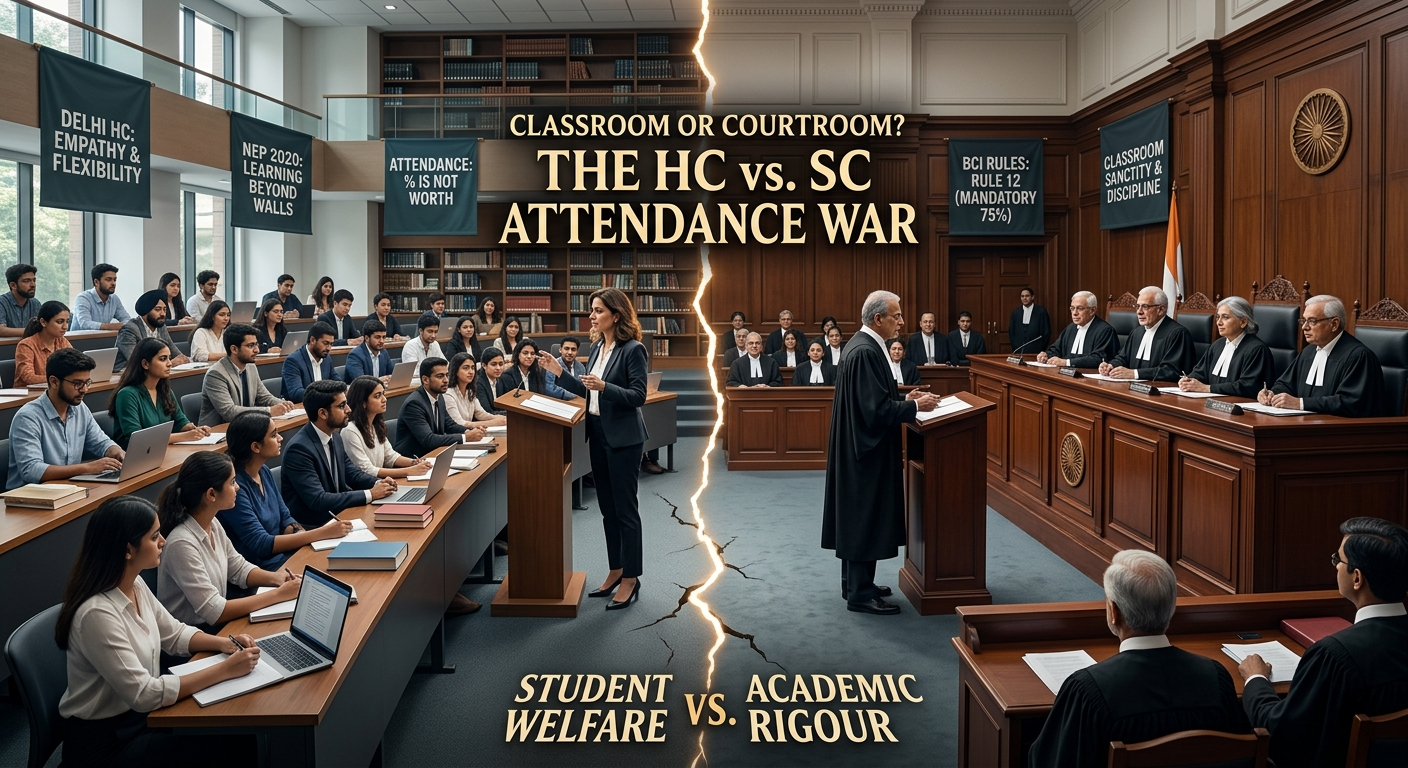
If you walk into any law school in India right now, the conversation isn’t about the latest basic structure doctrine or a landmark corporate merger.
It’s a math session. Students are staring at their phones, open-mouthed, calculating exactly how many lectures they can afford to miss without getting detained.
“If I skip tomorrow’s Constitutional Law class to attend my internship assessment, does my attendance drop to 74%?”
For decades, the 75% mandatory attendance rule has been treated by administrations like an untouchable, divine commandment. But recently, this anxiety exploded into a full-blown judicial war. With a landmark Delhi High Court judgment showing empathy for students, and the Supreme Court sharply firing back to protect the sanctity of the classroom, legal education is facing a crisis of identity.
So, who is right? The court trying to save students from burnout, or the court trying to save the sanctity of the classroom?
The High Court’s Stance
To understand why the Delhi High Court took a different view to the traditional attendance system, we have to look at the human tragedy that started it all.
This legal battle wasn’t sparked by a lazy student wanting to sleep in; it was born from the heartbreaking 2016 suicide of Sushant Rohilla, a third-year student at Amity Law School who was barred from writing his exams due to an attendance shortage. His death exposed a cold, bureaucratic system that valued attendance number over human life.
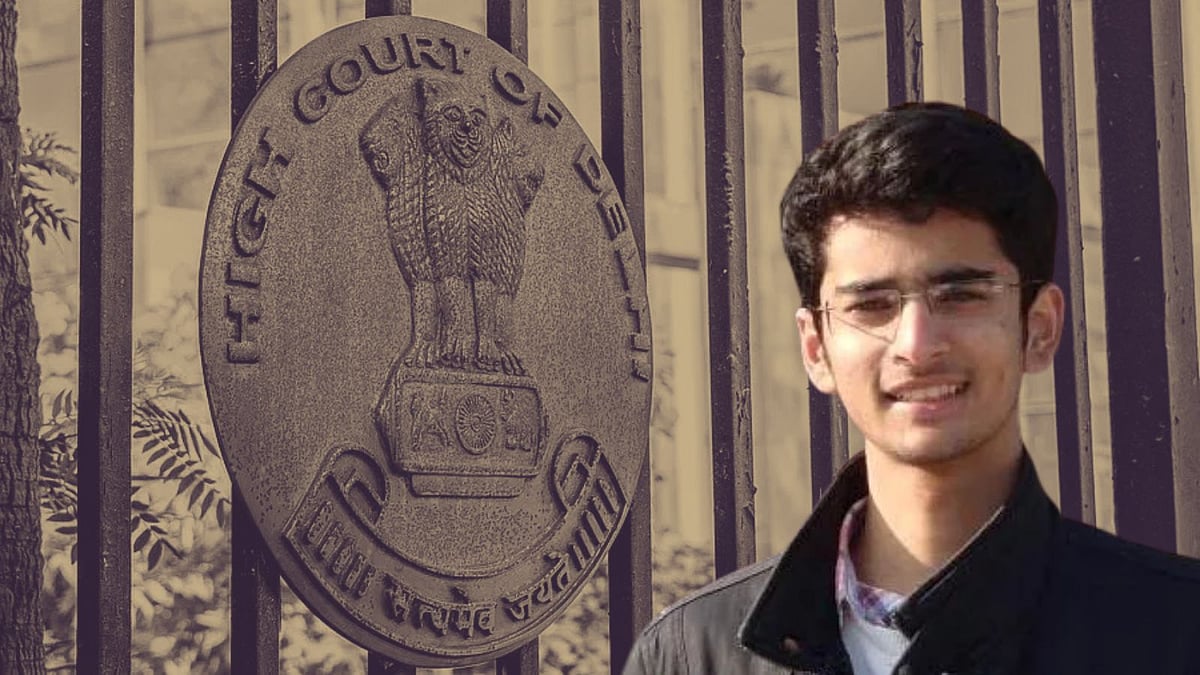
When a Division Bench of the Delhi High Court finally addressed this head-on, they didn’t just issue a standard legal directive. They showed rare, profound empathy. The High Court essentially argued that the traditional classroom is no longer the sole custodian of knowledge.
The Logic of the Modern Law Student
The High Court’s philosophy aligns with what modern students face every day:
-
Real Law Happens in the Trenches: Ask any practicing advocate where they learned to argue a bail application or draft a writ petition. It wasn’t in a two-hour lecture on the Sale of Goods Act; it was while learning it in a trial court internship, helping a legal aid clinic, or researching for a moot court competition. The HC recognized that punishing a student for actively engaging with the real world of law is completely counterproductive.
-
Proportionality, Not Destruction: Detaining a student, forcing them to repeat a year, and throwing a wrench into their career timeline is a totorous psychological and financial blow. The High Court pointed out that the punishment simply doesn’t fit the “crime.” Instead, they suggested mild, human alternatives, like, docking 5% of internal assessment marks, for instance. You lose a few points, but you don’t lose your dignity, your money, or a year of your life.
The Supreme Court’s Reality Check
However, the collective sigh of relief from student groups across India was short-lived. In May 2026, while hearing a challenge related to university attendance norms, a Supreme Court bench led by Justice Vikram Nath brought a heavy dose of institutional realism to the table.
While the apex court didn’t immediately pause the High Court’s order, their verbal warnings suggested something else.
The SC’s Concerns:
-
The “Five-Star Motel” Syndrome: The Supreme Court didn’t mince words. They warned that if you completely strip away the attendance requirement, premier campuses and National Law University (NLU) hostels will be reduced to mere “boarding and lodging facilities.” Why would a student pay massive tuition fees to live on a campus if they only use their room to sleep and completely bypass the academic ecosystem?
-
The Ghost Town Classroom: The apex court flagged that the sudden, extreme dilution of rules has created structural chaos. Imagine being a world-class professor, spending hours preparing a lecture on complex topics, only to walk into a classroom of hardly any percentage of people because everyone else is interning or studying from home. If no one shows up, the institutional fabric of legal education collapses.
-
The Discipline of the Robe: The legal profession is bound by strict rules, deadlines, and procedural decorum. The Bar Council of India (BCI) Rules on Legal Education explicitly mandate a 70% threshold for a reason. The Supreme Court’s perspective is that you cannot train disciplined officers of the court by teaching them as students that structural rules can simply be ignored when inconvenient.
The Verdict: We Need a Bridge, Not a Wall
For the community here at Lawlex, composed of students, young associates, and lawyers, this clash hits incredibly close to home. We live this reality. We know the exhausting, bone-tired feeling of rushing from a distant district court internship back to campus, only to be marked absent because we were ten minutes late. But we also know the immense value of a brilliant professor who changes the way you think about the legal system in a single, crowded lecture.
The High Court is entirely right: treating young adults like items on a biometric spreadsheet is an archaic, cruel way to run an educational institution. But the Supreme Court is also right: a professional degree cannot be earned via correspondence, and a legal community requires a shared physical space to thrive.
As the Supreme Court prepares to lay down the definitive law on this issue over the coming months, the legal fraternity isn’t hoping for a victory for either side.
We are hoping for a compromise. We need a system that respects the classroom but dynamically credits students for real-world legal work, medical emergencies, and mental health breaks. Until that balance is struck, thousands of students will continue to sit in classrooms, physically present, but mentally absent.
What is your experience with the 75% rule? Has it helped your discipline, or has it actively hurt your career growth and mental well-being? Let us know your thoughts in the comments below.