


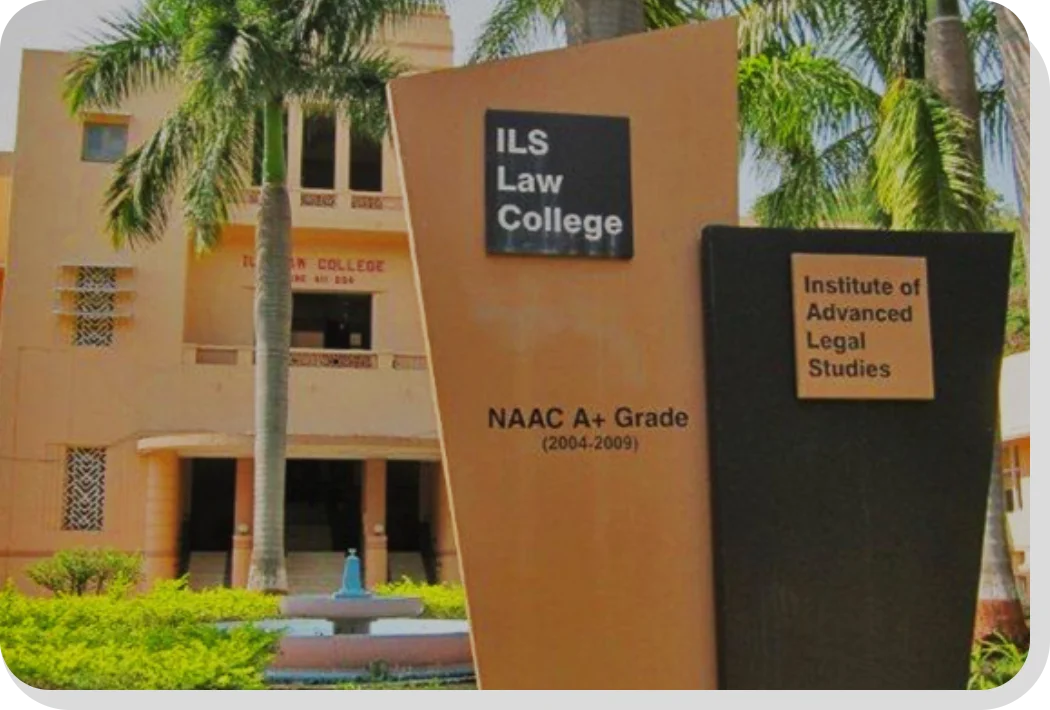
In a significant judicial development bringing major relief to law aspirants, the Bombay High Court has permitted students of ILS Law College, Pune, who were previously barred due to shortage of attendance, to sit for their semester-end examinations.
Background of the Dispute
The issue arose when 41 students enrolled across various academic years in both the 3-year and 5-year LL.B. programmes at ILS Law College were barred from taking their upcoming semester-end exams. The college administration imposed the bar after calculating the students’ attendance percentages, which ranged between 46% and 54.37%—falling below the standard mandatory threshold prescribed by academic and regulatory norms.
Faced with the prospect of losing an academic year, the affected students approached the Bombay High Court seeking urgent interim relief to allow them to sit for their examinations.
The Division Bench Hearing
The matter was heard by a Division Bench comprising Justice Riyaz Chagla and Justice Farhan Dubash.
During the proceedings, counsel representing Savitribai Phule Pune University (SPPU) and ILS Law College contended that mandatory attendance rules are vital to maintaining academic discipline and professional standards in legal education. The university argued that the Supreme Court’s recent precedent on attendance relief was narrowly tailored and applied solely to students appearing for their final examinations in three-year and five-year law courses.
However, the High Court Bench rejected this narrow interpretation. The court observed that barring students in earlier academic years (first, second, third, or fourth years) would lead to severe prejudice, causing them to forfeit an entire academic year. Consequently, the High Court held that the spirit of relief extended to final-year students should equitably apply to similarly situated students across all years of study.
Judicial Reasoning & Precedent Reliance
In allowing the petitions, the Bombay High Court placed reliance on a July 21 order of the Supreme Court of India. The apex court had granted one-time protection to law students whose ongoing academic sessions were impacted following a Delhi High Court ruling delivered in November 2025 regarding mandatory attendance requirements.
Key takeaways from the Bombay High Court’s ruling include:
-
Scope of Protection Extended: The High Court clarified that the Supreme Court had not fixed any specific minimum attendance percentage threshold for students seeking protection under its one-time relief order.
-
Inclusion of Non-Petitioners: Demonstrating an equitable approach, the Bench extended the benefit not only to the 41 petitioners before the court, but also to all other “similarly placed students” of the institute who had not formally approached the court.
-
Strict “One-Time Measure”: The Court explicitly emphasized that this decision is strictly a one-time exception for the 2025–26 academic year.
No Dilution of Future Attendance Rules
While the decision brings immediate reprieve to dozens of law students in Pune, the Bench made it clear that this ruling should not be treated as a permanent relaxation of regulatory standards. The court explicitly noted that the order:
-
Applies exclusively to the 2025–26 academic session.
-
Does not dilute or modify existing attendance regulations for subsequent academic years.
Going forward, legal education institutions and university bodies retain full authority to enforce statutory attendance mandates as prescribed by the Bar Council of India (BCI) and affiliated universities.
Legal Commentary & Implications
This judgment highlights the delicate judicial balancing act between enforcing academic discipline and preventing severe academic detriment to students. By anchoring its decision on the Supreme Court’s one-time transitional relief, the Bombay High Court ensured that procedural attendance shortfalls do not result in the disproportionate penalty of an entire lost year for affected law students—while firmly reaffirming that attendance mandates remain fully enforceable for future terms.