


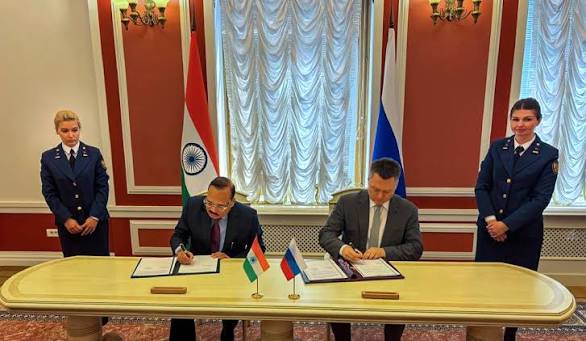
The Supreme Court of India and the Supreme Court of Russia have signed an agreement to cooperate with each other on judicial matters.
The agreement, known as a Memorandum of Understanding (MoU), was signed in Moscow by Chief Justice of India Surya Kant and the head of Russia’s Supreme Court, Chief Justice Igor Krasnov.
A common challenge for both countries
Speaking at Russia’s Supreme Court, Chief Justice Surya Kant said that even though India and Russia follow different legal traditions, both countries face the same problem: keeping people’s trust in the justice system while courts adapt to fast-moving changes in technology and society.
He said technology should help people get justice more easily, but it should never replace the judge who actually makes the decision.
How India is using technology in its courts
The Chief Justice shared some of the ways Indian courts are already using technology:
- SUVAS, a tool that translates court judgments from English into 16 regional languages.
- Su Sahay, a newly launched AI chatbot that helps lawyers, litigants and the public find information about court procedures, case status and filing requirements.
- One Case, One Data, an effort to create a single, standard digital record for every case across different court platforms.
- Greater use of technology for online arbitration and mediation, which helps settle disputes faster and at lower cost.
Technology can help, but judging stays human
Chief Justice Surya Kant was clear that justice must remain a human task. Artificial Intelligence can assist judges with things like translation, transcription and managing information, but it cannot decide the outcome of a case, judge whether a witness is telling the truth, weigh evidence or use a judge’s discretion.
He pointed to the Supreme Court’s recently issued draft rules on using AI in the courts, which aim to make sure AI is used responsibly while protecting the independence of judges and keeping humans in charge.
Hopes for the future
Wrapping up his speech, the Chief Justice said courts around the world are dealing with similar questions about new technology and public trust. He hoped India and Russia would work more closely through exchanges between their judicial academies, joint training, shared research and the sharing of best practices.
He added that the future of justice will depend on combining new technology with lasting human values, and expressed confidence that continued cooperation between the two courts would strengthen the justice systems of both countries.