


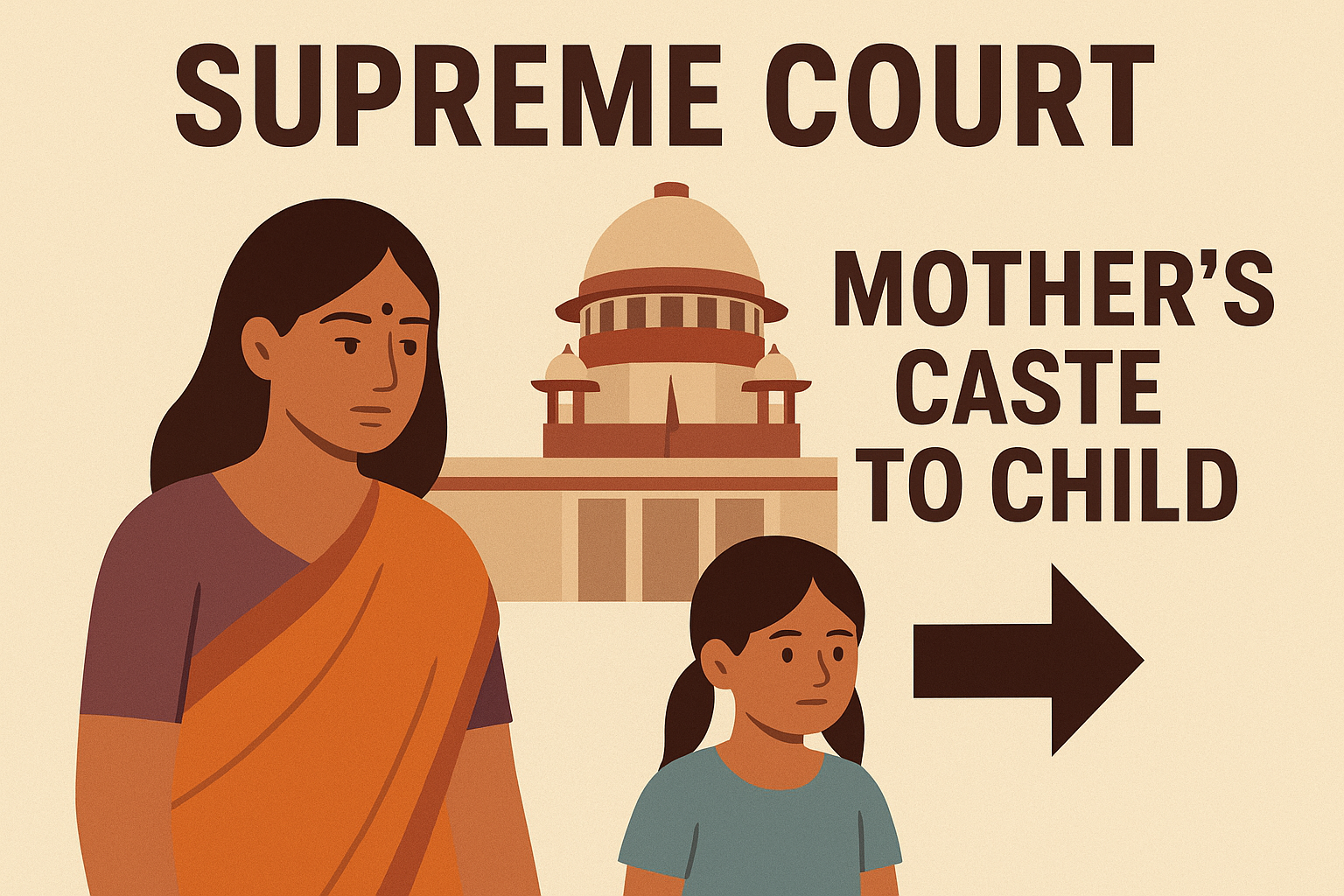
On 8 December 2025, a Bench headed by Surya Kant CJI, along with Justice Joymalya Bagchi, allowed a minor girl from Puducherry to obtain a Scheduled Caste (SC) certificate based on her mother’s caste, despite her father being from a non‑SC community.
This ruling marks a transformative moment in constitutional law concerning caste inheritance and reservation certificates.
Background: Legal Position on Caste Inheritance
Under long‑standing conventions, the caste of a child, for reservation and caste certificate issuance, is presumed to follow the father’s caste, especially under Hindu customary law. This principle was reaffirmed by the Court in Punit Rai vs Dinesh Chaudhary (2003), where it held that, in the absence of statutory law to the contrary, caste is inherited patrilineally.
However, the Court has previously recognised that this presumption need not be absolute. In Rameshbhai Dabhai Naika vs State of Gujarat (2012), it was observed that in the case of inter‑caste marriages (or union between tribal and non-tribal persons), while there is a presumption favouring the father’s caste, this presumption is “not conclusive or irrebuttable.” What matters is the fact whether the child was brought up in the mother’s community, faced the same social disabilities, deprivations, and was treated as a member of the mother’s community.
Thus, the jurisprudence before the present case allowed, in principle, for children born out of inter‑caste or tribal/n on‑tribal marriages to claim caste based on the mother, but only where evidentiary facts reflected that upbringing and social disadvantage. The burden of proof was on the claimant.
What the New Ruling Decides
In this latest case, the Supreme Court declined to interfere with the order of the Madras High Court, which had directed issuance of the SC certificate to the girl based on her mother’s caste (Adi Dravida), rejecting the non‑SC status of her father as determinative.
The Court explicitly left open the broader constitutional question of whether caste can be systematically inherited from the mother in all cases.
What Remains: Legal Uncertainty
It is important to note that the ruling does not declare a general principle that caste can always be inherited through the mother. It does not create a binding precedent for all future SC certificate claims based on maternal caste. It is restricted to the facts of this case.
That means each petition in future will still require a fact‑intensive inquiry: Where was the child raised? Which community’s social disadvantages did they experience? Which community’s social environment shaped their upbringing?
Without satisfying these factual thresholds, there is no guarantee of similar relief.
What the New Ruling Decides
During the hearing, the CJI asked a pointed question:
“With changing times, why should caste not follow the mother?”
This rhetorical question reflects the Court’s awareness of evolving social realities and the need to interpret caste inheritance norms in light of the present‑day situation. For children born of inter-caste or mixed-caste marriages (particularly where the mother comes from an SC/ST community), this judgment provides hope that their social identity can align with the mother’s community, provided facts support the same.
Conclusion
This ruling won’t solve every issue around caste certificates or inter-caste families, but it does open a window. For this young girl, her sense of belonging, the community in which she belonged, and the disadvantages she faced growing up came from her mother’s side — and the Court finally acknowledged that reality.
What are your thoughts? Does this ruling feel like a step forward, or does it open a debate we need to talk about more openly?
Tell us below!