



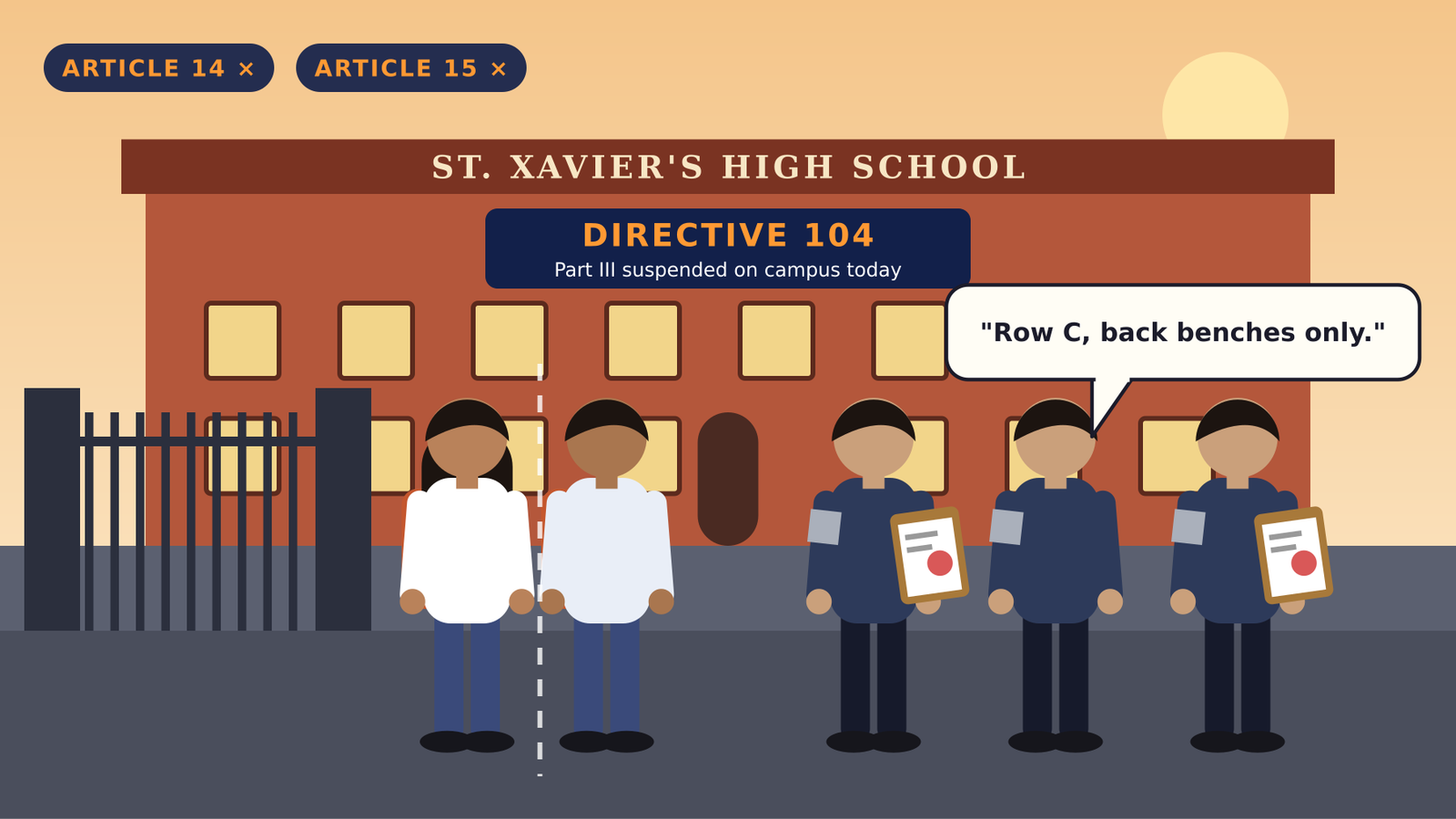
The morning bell at St. Xavier’s High School didn’t ring at 8:00 AM. Instead, a sharp chime echoed across the campus, followed by an announcement over the speakers: “Attention students and staff. Under Administrative Directive 104, Part III of the Constitution of India stands suspended on campus today for administrative efficiency.”
Ananya stood near the iron gates, tightening her grip on her backpack straps. Beside her, her best friend Kabir let out a short, nervous laugh. “Is this some kind of Constitution Day prank?”
“Doesn’t look like it,” Ananya said quietly, nodding toward the entrance.
The usual smiling guard was gone. In his place stood three senior prefects wearing grey armbands and holding clipboards with red stamps. They weren’t checking ID cards as students walked in. They were sorting people.
“Surname?” the tallest prefect asked when Kabir stepped up.
“Sharma,” Kabir said.
The prefect ran a finger down a sheet of paper. “Row C, back benches only. No computer lab access, and your lunch break is limited to the west courtyard. Next.”
Kabir blinked, refusing to budge. “Wait, why? Ananya and I are in the exact same section. We’re lab partners.”
The prefect didn’t even look up. “New classification rules. Article 14 is offline today. Equality before the rules isn’t a guarantee anymore. Neither is Article 15, so we can sort students however we please based on background or surname. Move along before you’re marked absent.”
Ananya opened her mouth to argue, then caught the warning look in Kabir’s eyes. Reluctantly, they walked inside, side by side in the hallway yet separated by a sudden, invisible wall.
Inside the main corridor, the usual morning noise of laughter, locker doors slamming, and last-minute homework copying had completely vanished. Students walked quickly with their eyes on the floor, whispering to each other.
Even the old honor roll board had been replaced with a fresh list of special titles and privileges reserved only for prefects and donors’ kids, mocking the very idea of Article 18 abolishing unfair titles.
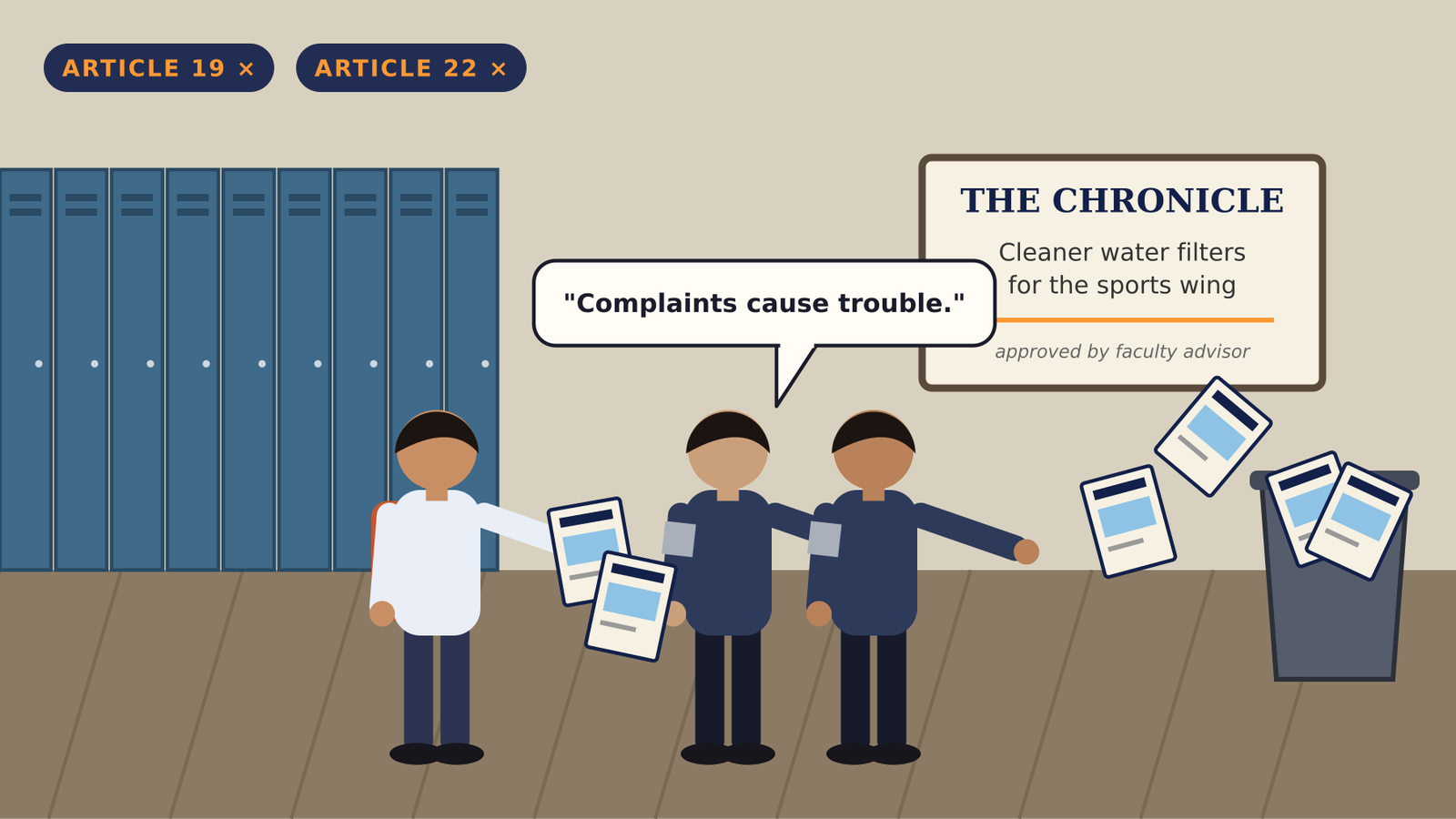
Near the stairs, Aarav, the editor of the school’s monthly magazine The Chronicle, stood frozen while two prefects pulled bundles of freshly printed copies right out of his hands.
“You can’t just take these!” Aarav said, his voice shaking with anger. “The faculty advisor already approved this issue. It’s just an article asking for cleaner water filters in the sports wing.”
“Complaints cause trouble,” the lead prefect said flatly, dumping the magazines into a trash bin. “With Article 19 suspended, your freedom of speech is gone. So is your right to gather with your editorial team or move freely around campus. Keep arguing, and we’ll see how long you sit in the basement detention room without anyone calling your parents.”
Aarav was shocked. The threat hung heavy in the air. Without Article 22, there was no protection against arbitrary detention and no right to even know why you were being locked up. A simple detention wasn’t a forty-minute punishment anymore. It was a black hole where nobody had to explain anything or let you call home. Aarav swallowed hard and stepped back without another word.
By second period, the missing rights had crept into every corner of the school. During Chemistry, Mr. Verma handed out the lab kits, giving brand-new glassware to the front rows while passing chipped, broken trays to the students pushed to the back. When Ananya raised her hand to protest, Mr. Verma simply pointed to the blackboard, where someone had written in white chalk: No Dignity, No Remedies.
At lunchtime, the canteen felt less like a hangout spot and more like a checkpoint. Riya, who was waiting near the entrance, looked like she was about to cry.
“They barred me from the main drinking fountain,” Riya whispered to Ananya. “One of the seniors said my family’s old neighborhood makes me ‘unfit’ to share the common tap. When I reminded him that Article 17 abolished untouchability and social exclusion, he just laughed and told me to read today’s notice.”
A few tables away, Maya was staring down at her untouched lunchbox, looking pale. She had spent weeks practicing a classical Carnatic song for the school’s cultural event, only to be told that regional languages and traditional performances were banned under the new campus rules. With Article 29 and Article 30 gone, minorities had no right to protect their language, culture, or run their own educational spaces. Even the quiet prayer room near the library had been locked shut, stripping away Articles 25 to 28, the freedom to practice and follow one’s own faith without interference.
Ananya felt a heavy ache in her chest. Until that morning, she had only ever seen Fundamental Rights as bold headings in her civics textbook, things you memorize the night before an exam and forget once the paper is over. She had never realized how quietly those rules held up everyday life, keeping power from spilling over its banks.
The worst shock came during the sixth-period assembly. The whole school was called into the main hall. The Principal stood at the podium, flanked by the grey-armbanded prefects, his face completely unreadable.
“Starting tomorrow,” the Principal announced into the microphone, “the annual sports week is canceled. Instead, every student from Grades 9 to 12 will report to the east ground for the next four Saturdays to clear rubble and pave the new staff parking lot. Attendance is compulsory. Nobody will be paid, and no academic credits will be given.”
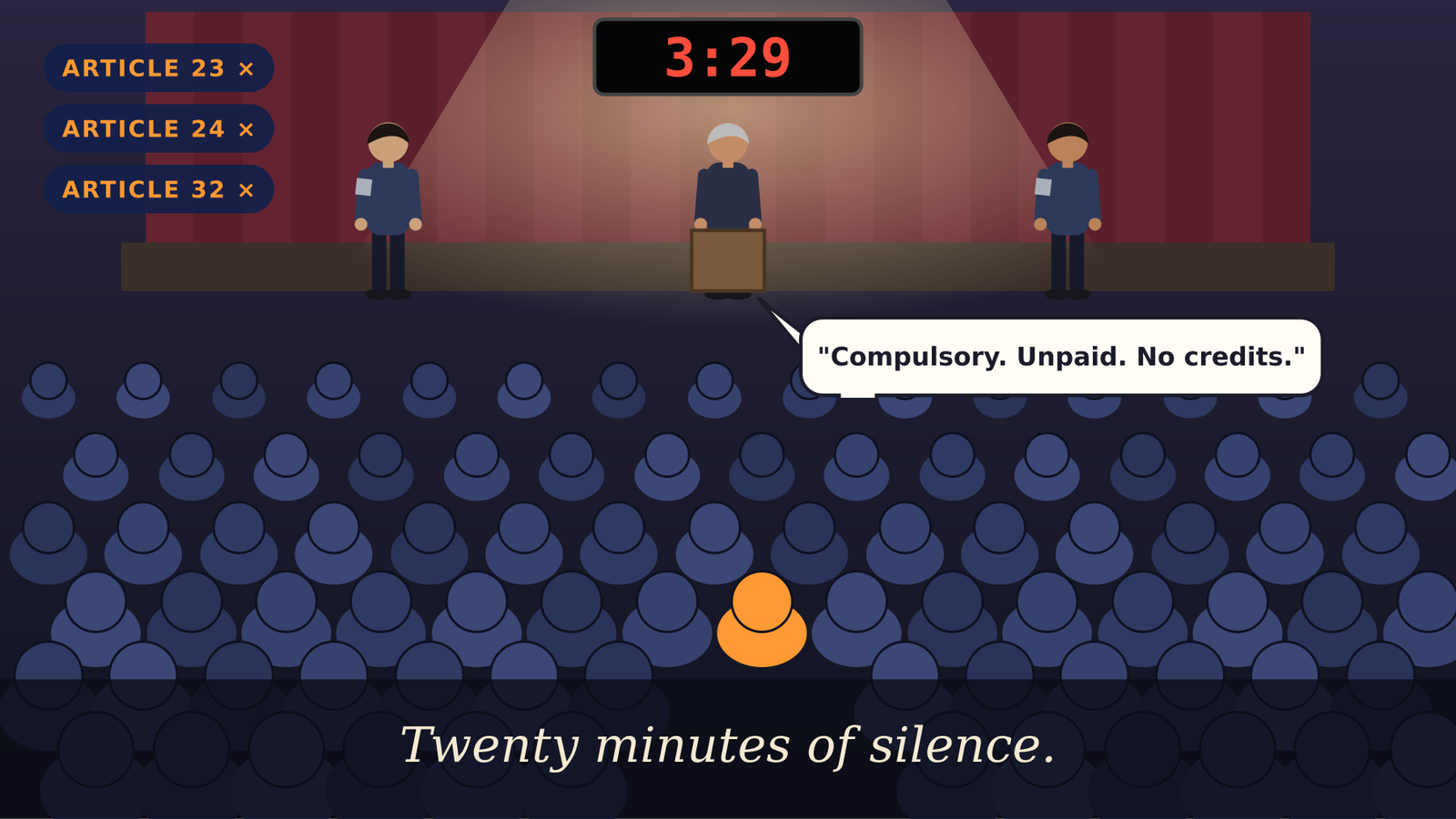
A stunned murmur ran through the hall. Forced, unpaid labor? Without Article 23, there was nothing stopping the school from forcing students to work against their will. Even worse, she noticed a group of twelve-year-olds from the middle school wing being handed heavy brooms and buckets at the back door, a sight that Article 24 would have normally made illegal to protect children from hazardous work.
She looked across the hall at Kabir sitting alone in Row C, and over at Aarav gripping the edge of his chair. On any normal day, a decision like this would have sparked a student walkout, a petition signed by hundreds of parents, or a formal complaint to the education board. Even the Right to Education under Article 21A and the basic right to live with dignity under Article 21 felt like distant memories, traded away for blind obedience.
Then the final realization hit her like cold water. Article 32 was gone too.
The Right to Constitutional Remedies, the very thing Dr. B.R. Ambedkar called the heart and soul of the Constitution, had vanished. Even if someone broke every rule of fairness and basic humanity, there was no court to go to, no writ to file, and no higher authority forced to listen. Without a way to fight back in court, a right wasn’t a shield at all. It was just a polite wish written on paper.
For twenty long minutes, the auditorium sat in suffocating silence. Nobody raised a hand. Nobody stood up. Fear had done what no lock or chain ever could, convincing four hundred teenagers to police themselves.
Then, the digital clock above the stage clicked from 3:29 PM to 3:30 PM.
A soft chime rang out over the speakers.
“Directive 104 has ended,” the Principal’s voice echoed, sounding warm and familiar again. “Part III of the Constitution of India is restored.”
For five full seconds, nobody moved. The silence felt fragile, like everyone was testing whether the air was safe to breathe again.
Slowly, the prefects stepped down from the stage and unpinned their grey armbands. In the third row, Aarav reached under his seat, pulled out a stray copy of The Chronicle, and held it up. Across the aisle, Kabir stood up, walked straight past the Row C barrier, and dropped into the empty chair next to Ananya.
“You okay?” Kabir asked softly.
Ananya looked around the hall at Riya smiling with her friends, at Maya pulling out her sheet music, and at the invisible weight lifting off four hundred shoulders at once.
“Yeah,” Ananya said, letting out a breath she felt like she’d been holding since 8:00 AM. “I just never realized how loud silence could be.”
Walking out of the school gates into the warm afternoon sun, Ananya didn’t just see a building of brick and cement anymore. She saw an invisible shield made of Articles 14 through 32 standing quietly between every person and unchecked power, proving that rights aren’t favors handed out on good days. They are the very reason ordinary life is possible at all.