


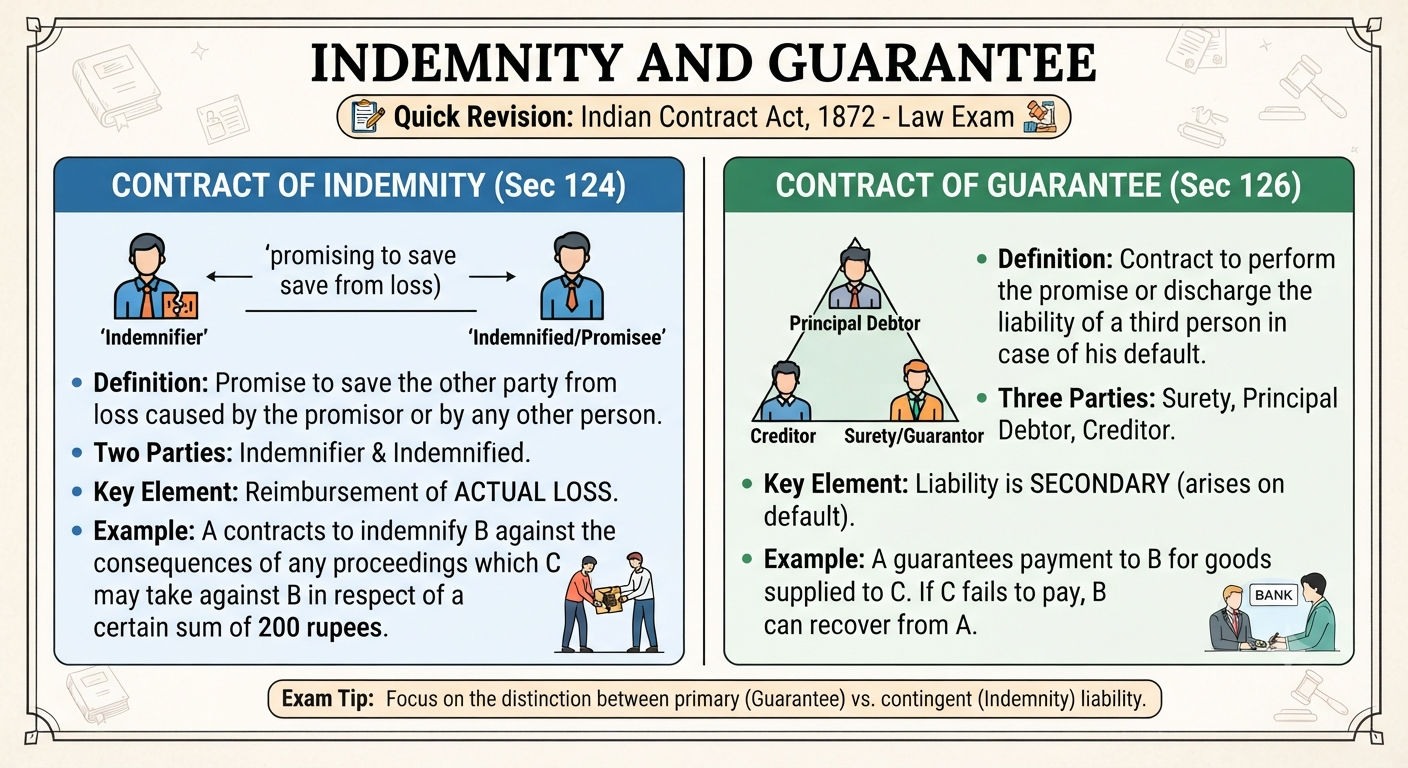
Contract of Indemnity (Sections 124 & 125)
1.1 Meaning & Concept
- Contract of indemnity is a species of general contract, and the general principles of the law of contract apply to it.
- Chapter VIII (Sections 124 & 125) of the Indian Contract Act, 1872 deals with indemnity provisions.
- In English law, ‘indemnity’ means “a promise to save a person harmless from the consequences of the act” (which may be express or implied).
1.2 Definition & Parties (Section 124)
- Section 124: A contract by which one party promises to save the other from loss caused to him by the conduct of the promisor himself, or by the conduct of any other person, is called a “contract of indemnity”.
- Parties involved:
- Indemnifier (Promisor): The person who promises to make good the loss.
- Indemnity-Holder / Indemnified (Promisee): The person to whom the promise is given and whose loss is to be compensated.
Statutory Illustrations:
- A contracts to indemnify B against the consequences of any proceedings which C may take against B in respect of a certain sum of 200 rupees.
- A and B go into a shop. B says to the shopkeeper, “Let A have the goods. I will see that you are paid.” This is a contract of indemnity.
1.3 Essential Ingredients
- Existence of a valid contract.
- A promise made by one party to another.
- The promise must be to save the other party from loss.
- The loss must be caused by the conduct of the promisor or any other person.
1.4 Nature and Scope of Contract of Indemnity
- Narrow Indian Scope: Section 124 limits indemnity strictly to losses caused by human agency (conduct of the promisor or a third party).
- Wider English Law: English law covers losses caused by events, accidents, or acts done by the promisee at the request of the promisor.
- Law Commission Recommendation: The Law Commission of India (13th Report, 1958) recommended expanding Section 124 to cover losses caused by events/accidents independent of human conduct and to explicitly include implied promises.
1.5 Rights of Indemnity-Holder / Extent of Liability (Section 125)
When acting within the scope of authority, the indemnity-holder is entitled to recover:
- All damages compelled to pay in any suit regarding the indemnified matter.
- All costs incurred in bringing or defending a suit, provided he did not contravene the orders of the promisor and acted prudently, or was authorized by the promisor.
- All sums paid under the terms of a compromise, provided the compromise was not contrary to orders, was prudent, or was authorized by the promisor.
- Nature of Liability: The liability is compensatory and contingent on actual loss/payment required.
Contract of Guarantee (Sections 126–147)
2.1 Definition & Essential Ingredients (Section 126)
- Section 126: A contract of guarantee is a contract to perform the promise, or discharge the liability, of a third person in case of his default.
- Parties involved:
- Surety: The person who gives the guarantee.
- Principal Debtor: The person in respect of whose default the guarantee is given.
- Creditor: The person to whom the guarantee is given.
- Form: May be oral or written.
- Structure: Tripartite contract involving three agreements.
2.2 Functions & Kinds of Guarantee
- Functions: Enables obtaining loans, credit purchases, or employment fidelity.
Kinds of Guarantee:
- Specific (Simple) Guarantee: Given for a single transaction or debt.
- Continuing Guarantee: Extends to a series of transactions and remains in force until revoked.
2.3 Nature of Contract of Guarantee
- It is a collateral (conditional) contract, ancillary to the principal obligation.
- Requires the existence of an underlying debt or obligation of a principal debtor.
- Liability is contingent upon the default of the principal debtor.
- Comparison: Indemnity vs. Guarantee
| Feature | Contract of Indemnity (Section 124) | Contract of Guarantee (Section 126) |
| Parties | Two (Indemnifier & Indemnity Holder) | Three (Creditor, Principal Debtor, Surety) |
| Contracts | One contract (Indemnifier & Indemnity Holder) | Three contracts (Debtor-Creditor, Debtor-Surety, Surety-Creditor) |
| Primary Liability | Primary & independent on Indemnifier | Primary on Principal Debtor; Secondary on Surety |
| Request | Indemnifier need not act at request of holder | Guarantee must be at request of Principal Debtor |
| Contingency | Arises on happening of contingency | Arises on default of existing debt/duty |
| Right to Sue | Cannot sue third party directly without assignment | Surety steps into creditor’s shoes (subrogation) on payment |
- Liability of the Surety
4.1 Extent of Surety’s Liability (Section 128)
- The liability of the surety is co-extensive with that of the principal debtor, unless otherwise provided by contract.
- Illustration: A guarantees payment of a bill of exchange by C (acceptor). On dishonor by C, A is liable for the bill amount plus interest and accrued charges.
4.2 Liability of Co-Sureties (Sections 146 & 147)
- General Rule: Principle of joint and several liability.
- Co-sureties liable to contribute equally (Section 146):
- In the absence of a contract to the contrary, co-sureties for the same debt (whether joint or several, under same or different contracts) are liable to pay equal shares of the debt.
- Illustrations:
- A, B, C guarantee Rs. 3,000 for E. On default, each pays Rs. 1,000.
- If contracted liability proportions are A (1/4), B (1/4), C (1/2) for Rs. 1,000 debt; A pays 250, B pays 250, C pays 500.
- Co-sureties bound in different sums (Section 147):
- Co-sureties bound in different maximum limits contribute equally up to their respective limits.
- Illustrations:
- Limits: A = 10,000; B = 20,000; C = 40,000. Default = 30,000 Each pays 10,000.
- Limits: A = 10,000; B = 20,000; C = 40,000. Default = 40,000 A pays 10,000; B and C pay 15,000 each.
- Limits: A = 10,000; B = 20,000; C = 40,000. Default = 70,000 Each pays full penalty limit.
- Discharge of Surety
Discharge refers to the termination/cessation of the surety’s liability.
5.1 By Revocation
- Notice by Surety (Section 130): A continuing guarantee may be revoked for future transactions by notice to the creditor. (Accrued liabilities remain binding).
- Death of Surety (Section 131): Operates as revocation of a continuing guarantee for future transactions unless contracted otherwise.
- Novation (Section 62): Substitution of a new contract of guarantee discharges the original contract.
5.2 By Conduct of the Creditor
- Variance in Terms (Section 133): Any unconsented variance in the principal contract discharges the surety for subsequent transactions.
- Release/Discharge of Principal Debtor (Section 134): Surety is discharged if the creditor releases the debtor, or by any act/omission that legally discharges the debtor.
- Compounding or Giving Time (Section 135): Contract to compound, extend time, or agree not to sue the debtor discharges the surety unless consented to.
- Exceptions:
- Agreement to give time made with a third party does not discharge surety (Section 136).
- Mere forbearance to sue does not discharge surety (Section 137).
- Release of one co-surety does not discharge others (Section 138).
- Exceptions:
- Impairment of Surety’s Remedy (Section 139): Any act or omission by the creditor inconsistent with the surety’s rights or impairing the surety’s remedy against the principal debtor discharges the surety.
- Loss of Security (Section 141): If the creditor parts with or loses security held at the time of contract without the surety’s consent, the surety is discharged to the extent of the security’s value.
5.3 By Invalidation of Contract
- Misrepresentation (Section 142): Guarantee obtained by creditor’s misrepresentation regarding a material part is invalid.
- Concealment (Section 143): Guarantee obtained by creditor keeping silence on material circumstances is invalid.
- Failure of Co-surety to Join (Section 144): If guaranteed on condition that another co-surety joins, the contract is invalid if that person fails to execute it.
- Failure of Consideration (Section 25): Absence or failure of consideration renders the guarantee void.
You are doing great, believe in yourself and ace the exam!
Team LawLex wishes you all the very best.