


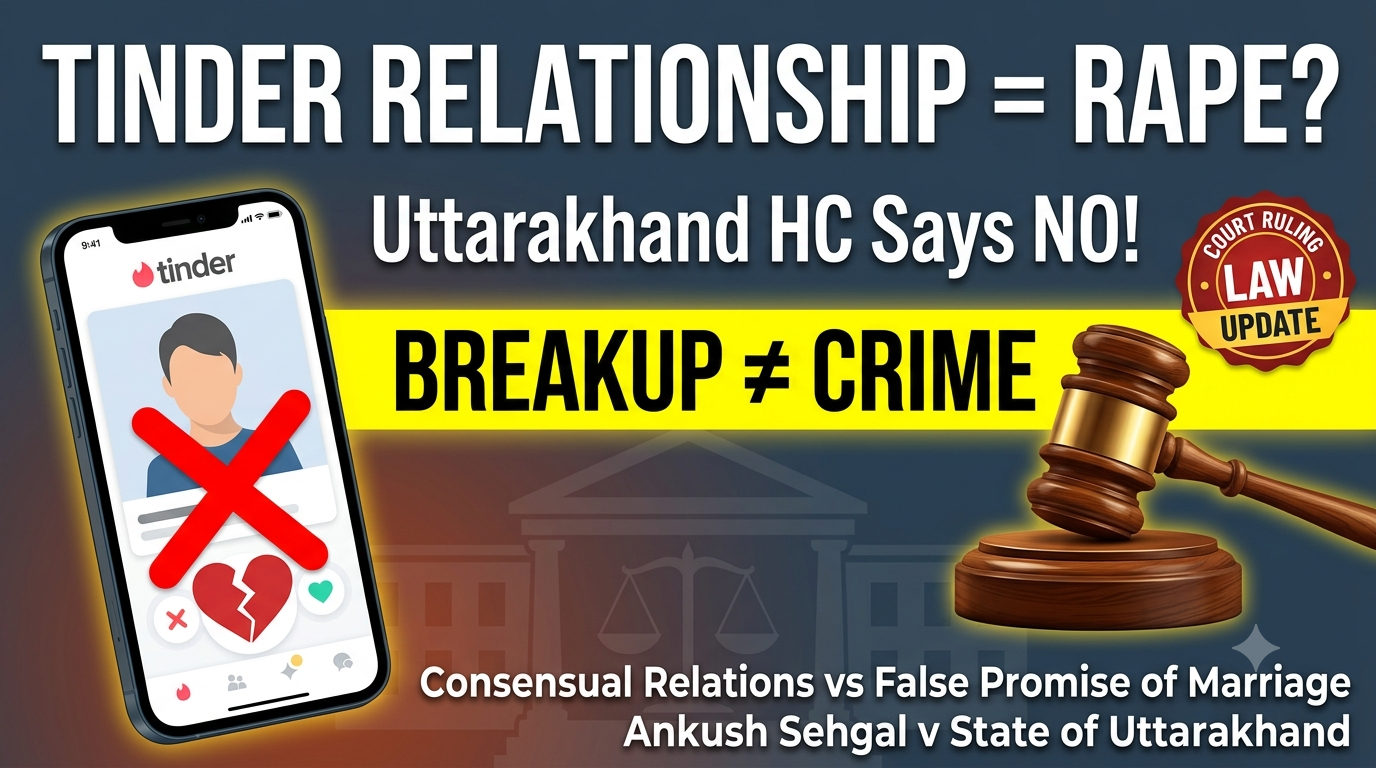
Case Overview
-
Case Name: Ankush Sehgal v. State of Uttarakhand
-
Citation: 2026 SCC OnLine Utt 1837
-
Court: High Court of Uttaranchal (Uttarakhand High Court)
-
Bench: Hon’ble Justice Siddhartha Sah
-
Key Provisions: Section 376 of the Indian Penal Code (IPC) & Section 482 of the Code of Criminal Procedure (CrPC)
Introduction
Can a broken relationship that started on a dating app lead to rape charges if it does not end in marriage? The High Court of Uttaranchal recently addressed this important question.
In a notable judgment, the High Court held that if two consenting adults meet on a dating app like Tinder and enter into a physical relationship, the failure of that relationship to end in marriage does not automatically make it a case of rape on the “false pretext of marriage.” Quashing the criminal proceedings, the Court emphasized that a relationship turning sour cannot be equated with criminal intent from the very beginning.
The Background Facts
The case originates from an FIR registered on March 9, 2021, by the complainant (Respondent No. 2) under Section 376 (rape) of the IPC.
-
How They Met: According to the FIR, the woman met the applicant (Ankush Sehgal) through the popular dating app Tinder in August 2019. They became close friends and regularly communicated over phone calls.
-
The Incidents: During their friendship, the man visited her, and they went on trips together. The complainant alleged that during one such trip, both of them consumed liquor, and a physical relationship was established in a hotel room while under intoxication. She claimed he assured her he would not do anything wrong.
-
Continuation & Breakdown: The relationship continued for a considerable time. The applicant regularly traveled to meet her on every second and fourth Saturday. However, after the COVID-19 lockdown period, the man began avoiding her and eventually refused to marry her, citing his father’s poor health.
-
The FIR: The complainant later discovered through Instagram that the man had gotten engaged to someone else. She then filed an FIR alleging rape on the false promise of marriage.
Following an investigation, the police filed a charge-sheet, and the magistrate issued a summoning order taking cognizance of the offence. The accused then moved the High Court under Section 482 of the CrPC to quash the charge-sheet and all criminal proceedings.
Arguments Presented in Court
-
Arguments by the Applicant (Accused):
-
The relationship was entirely consensual between two mature adults.
-
Tinder is a social discovery and dating app meant for making friends and dating—it is not a matrimonial website where marriage commitments are formally made.
-
There was a significant unexplained delay of nearly 1 year and 7 months between the alleged refusal to marry and the filing of the FIR.
-
The FIR lacked specific dates of the alleged incidents, and the complainant had declined an internal medical examination, leaving no medical corroboration.
-
The complainant’s own statement recorded under Section 164 CrPC clearly showed that she was a consenting partner throughout the long-standing relationship.
-
-
Arguments by the State/Complainant:
-
The physical relationship was established only because the accused promised to marry her, and breaking that promise constituted an offence under Section 376 IPC.
-
Key Findings & Legal Analysis by the Court
Justice Siddhartha Sah evaluated the material on record and highlighted several critical legal and factual aspects:
1. Dating Apps vs. Matrimonial Platforms
The Court took note of the nature of Tinder as a platform meant primarily for socialization and dating among young people, rather than a formal matrimonial portal. The voluntary nature of the connection established on such an app pointed toward a relationship entered into by free choice.
2. Consensual Relationship of Long Duration
The record showed that both individuals were mature adults who engaged in physical intimacy out of their own free will. The relationship went on over a long period, with frequent meetings and travel. This consistent engagement over months demonstrated mutual consent rather than coerced or tricked submission.
3. Supreme Court Precedents Applied
The High Court relied on recent Supreme Court rulings, including Biswajyoti Chatterjee v. State of W.B. (2025) and Samadhan v. State of Maharashtra (2025). The law established by the apex court clarifies that:
-
A false promise of marriage exists only if the accused had no intention of fulfilling the promise right from the inception (the very beginning) of the relationship.
-
If a genuine relationship breaks down later due to changed circumstances, family objections, or incompatibility, it does not amount to a false promise or rape.
4. Lack of Evidence and Delay
The Court noted the unexplained delay of over a year and a half in lodging the FIR, the absence of specific dates of alleged incidents, and the complainant’s refusal to undergo a medical examination.
The Final Decision
The High Court held that continuing the criminal prosecution against the applicant under Section 376 IPC would amount to a clear abuse of the process of law.
“If subsequently, the relationship turns sour and did not culminate in marriage, that by itself cannot be a ground to term the relationship between the parties as one involving physical relationship on the false pretext of marriage.”
Accordingly, the High Court allowed the application under Section 482 CrPC and quashed the charge-sheet, summoning order, and criminal proceedings against Ankush Sehgal.
Key Takeaway & Significance
This judgment re-emphasizes a crucial legal boundary in Indian jurisprudence: the distinction between a breach of promise and a false promise.
-
Breach of Promise: A relationship entered into in good faith that fails or falls apart over time over valid issues. This is a civil or personal matter, not a crime.
-
False Pretext: A dishonest misrepresentation made right from day one solely to obtain consent for physical intimacy, with no intent to marry. Only this scenario attracts criminal liability under rape laws.
The judgment brings welcome clarity for modern dating scenarios, reaffirming that adult consensual relationships that fail do not automatically turn into criminal offences when expectations change.