


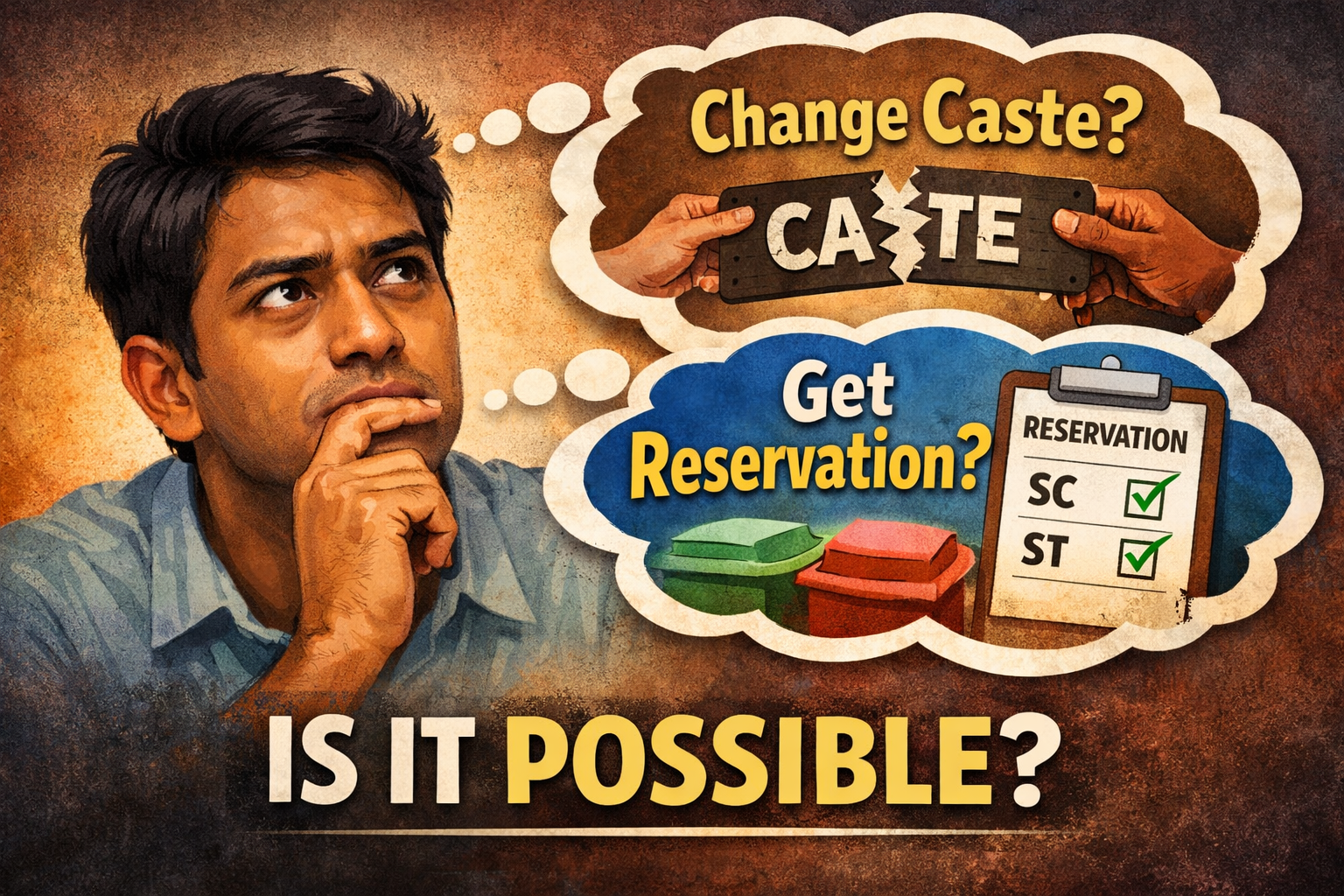
Caste in India is not just a social label. It decides access to education, jobs, and constitutional benefits. This is why a question that keeps coming up, both in courts and in everyday conversations, is this: if a person changes their caste through marriage, conversion, or personal choice, do they get reservation benefits?
The short answer is uncomfortable but clear. Reservation is not something you can opt into by changing your caste later in life.
Why birth matters more than choice
Reservation exists to correct historical and structural disadvantage. Courts have repeatedly said that this disadvantage begins at birth and shapes a person’s entire social experience. Discrimination is not a switch that turns on after marriage or conversion. It is something that follows a person from childhood, in school, in neighbourhoods, and in social interactions.
Because of this, Indian constitutional law treats caste as a birth-based social reality, not a personal preference.
What happens when someone marries into a backward caste?
This issue was settled decades ago in Valsamma Paul v. Cochin University (1996). The Supreme Court held that a person born into a forward caste does not become eligible for reservation simply by marrying into a Scheduled Caste or Other Backward Class.
The Court’s reasoning was simple and powerful. Marriage may change social association, but it does not recreate the lived experience of exclusion and humiliation that reservation seeks to remedy. Allowing reservation in such cases would dilute benefits meant for communities that have faced generational oppression.
Does religious conversion change anything?
Conversion also does not automatically unlock reservation benefits.
In Soosai v. Union of India (1985), the Supreme Court made it clear that Scheduled Caste status is tied to specific social disabilities rooted in caste hierarchy. Conversion, by itself, does not prove that those disabilities continue. Courts require strong evidence that discrimination persists even after conversion, and such claims are examined very strictly.
The narrow exception courts recognise
There is one limited situation where courts have shown flexibility.
If a person is originally born into a Scheduled Caste or Tribe, later converts to another religion, and then reconverts back, reservation benefits may be restored. But even here, it is not automatic.
In K.P. Manu v. Chairman, Scrutiny Committee (2015), the Supreme Court said that reconversion must be genuine and must be followed by real acceptance by the community. Authorities look at social interaction, marriage practices, participation in customs, and everyday treatment. A certificate alone is not enough.
What about children from inter-caste marriages?
This is one of the most misunderstood areas of reservation law.
In Rameshbhai Dabhai Naika v. State of Gujarat (2012), the Supreme Court clarified that a child’s caste is not decided mechanically by the father or the mother. What matters is how the child was brought up, which community they were socially identified with, and whether they actually faced discrimination.
Reservation is not inherited on paper. It depends on social reality.
Why courts draw such a hard line
Judges have consistently warned that reservation cannot become a tool for social mobility through paperwork. It is meant to compensate for systemic exclusion, not individual disadvantage.
Allowing people to claim reservation simply by changing caste would:
- Undermine the purpose of affirmative action
- Encourage misuse of caste certificates
- Reduce opportunities for those who genuinely need protection
This is why scrutiny committees and courts apply such strict standards.
So where does the law stand today?
Changing caste through marriage, conversion, or self-declaration does not entitle a person to reservation benefits. The only exceptions are rare and fact-specific, usually involving reconversion or children who can prove upbringing within a disadvantaged community.
Caste, in the eyes of the law, is not about who you choose to be. It is about what society has historically made you endure.