


Why IndiGo Flights Are Getting Cancelled: A Legal Breakdown of the Crisis
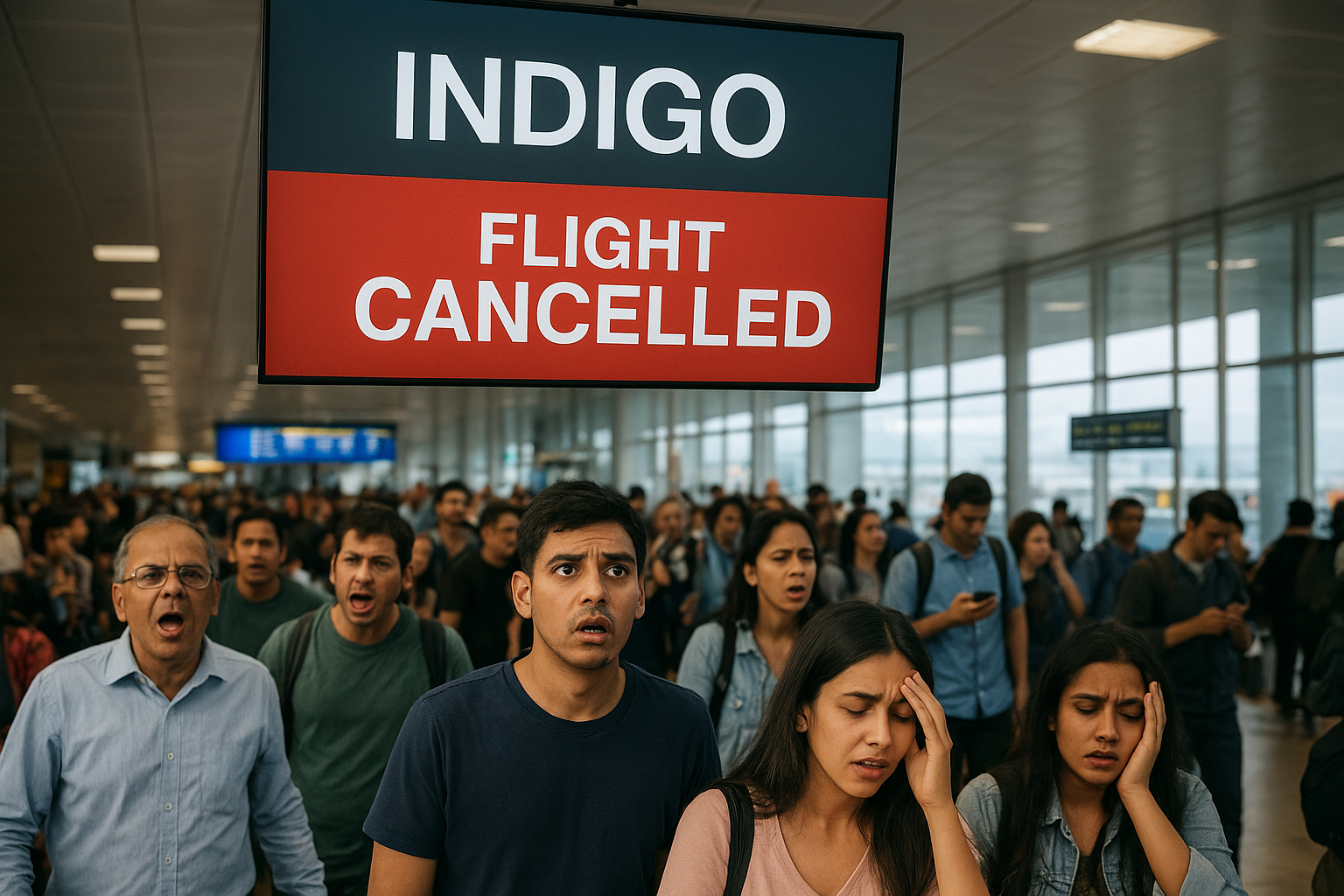
Across India’s airports — from Mumbai to Delhi to Bengaluru — travellers are seeing chaos. On some days, hundreds of flights of IndiGo are being cancelled or delayed. On 5 December alone the numbers were staggering: over 500 flights reportedly delayed or cancelled.
For many passengers, the airports have turned into crowded waiting halls, with long lines, confusion over updated flight-status messages, and people stranded for hours.
Behind this chaos is a story of new aviation regulations, airline planning failures, and long-standing concerns about crew fatigue. And legally, this situation is far bigger than just “operational issues”.
Let’s break it down.
1. The Current Scene: What Passengers Are Seeing
IndiGo, India’s largest domestic airline, has faced a wave of cancellations and delays across nearly all major airports. On some days, over 500 flights were disrupted. On-time performance has fallen sharply, and airport terminals have become crowded with confused passengers waiting for clarity.
The airline’s public explanation has been vague: “unplanned crew unavailability”. But legally, the reasons go much deeper.
2. The Legal Trigger: Revised FDTL Regulations
The disruption began soon after the Directorate General of Civil Aviation (DGCA) enforced revised Flight Duty Time Limitations (FDTL) from 1 November 2025.
These regulations govern how long pilots and cabin crew can legally work. They are designed to prevent fatigue — one of the biggest risk factors in aviation safety.
Key legal changes under the new FDTL:
- Expanded definition of night duty
- Fewer night landings allowed
- Stricter weekly rest requirements
- Stricter limits on consecutive night duties
- Tighter monitoring of cumulative fatigue
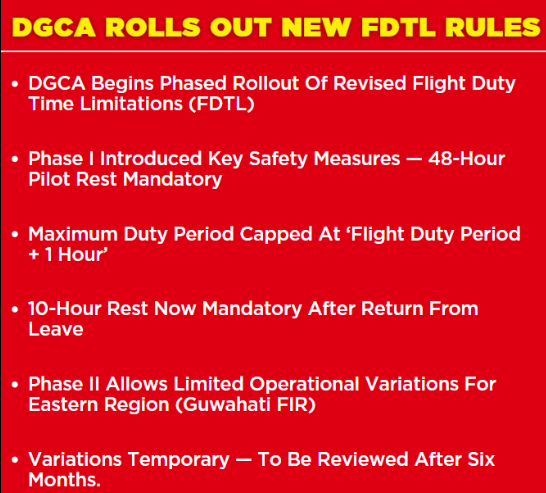
Under Indian aviation law, no airline can operate a flight if the assigned crew would exceed these duty limits. Violating FDTL is a direct breach of the Civil Aviation Requirements (CARs) and can attract penalties, suspension, and safety audits.
This means:
If IndiGo doesn’t have enough rested crew to legally operate a flight, it must cancel it.
3. Why IndiGo Was Hit the Hardest
Legally speaking, every airline in India is bound by the same FDTL rules. Yet IndiGo collapsed first. Why?
A few reasons stand out:
(a) Lean manpower strategy
Pilot unions have long claimed that IndiGo maintained the minimum required number of crew. This “lean staffing model” allowed the airline to keep costs low, but left almost no space for emergencies, sudden fatigue issues, or regulatory changes.
(b) Failure to prepare during the transition period
The DGCA did not introduce these rules overnight. The industry had nearly two years to prepare.
The allegation is simple: IndiGo did not hire, train, or build reserves in time.
(c) High night-time operations
IndiGo operates a large number of night flights. Under stricter night-duty limits, a much larger portion of their roster suddenly became illegal to operate.
(d) The legal constraint
IndiGo could not simply ask pilots to work more.
FDTL rules are non-negotiable.
If a pilot exceeds duty hours, even by a small margin, the airline can face regulatory action.
So the cancellations were not just a “choice”, they were a legal necessity.
4. A Look Back: IndiGo’s History of Overworking Crew
The current crisis did not emerge in one week. It has roots in the airline’s past working practices.
For years, pilots and cabin crew have flagged:
- High flight utilisation
- Intense turnaround schedules
- Limited weekly off days
- Rosters planned at the upper edge of legal limits

Many crew members reported that while IndiGo technically complied with the minimum regulatory requirements, the airline used those limits to the maximum, leaving staff exhausted and overstretched.
This is important because FDTL rules were updated precisely because fatigue-related risks were increasing across the Indian aviation sector. The regulator tightened the law; IndiGo didn’t expand capacity to match it.
The legal chain is clear:
Old practices → new rules → insufficient crew → mass cancellations.
5. Temporary Relief — But With Concerns
Facing nationwide disruption, the DGCA granted IndiGo a one-time exemption from certain FDTL requirements, valid until 10 February 2026.
This included relaxed night-duty restrictions and eased weekly rest calculations.
However, aviation lawyers and pilot associations warn that this exemption could undermine the very safety purpose behind the new FDTL norms.
There is also public concern that such relaxations were granted only after chaos, which may set a difficult precedent.
6. Conclusion: What Needs to Change
This crisis is not just about one airline’s mismanagement. It raises deeper questions about the balance between commercial operations and aviation safety, and how strictly India enforces fatigue-related regulations.
Suggestions going forward:
1. Airlines must maintain realistic crew reserves
Lean staffing looks efficient until the law tightens. Adequate pilot and cabin crew strength must be a legal requirement for large carriers.
2. Stronger enforcement of FDTL norms
DGCA should ensure airlines do not operate at the “legal edge” of crew fatigue limits.
3. Mandatory fatigue-risk management systems (FRMS)
Airlines should implement scientifically monitored systems, not just paper-based rosters.
4. Long-term safety over short-term profits
Aviation law is built around one core principle: safety first.
Airline scheduling and manpower planning must align with that principle — not just revenue targets.
The IndiGo crisis is a reminder that aviation safety is everyone’s business. I’m curious to hear your take! What should change first?