


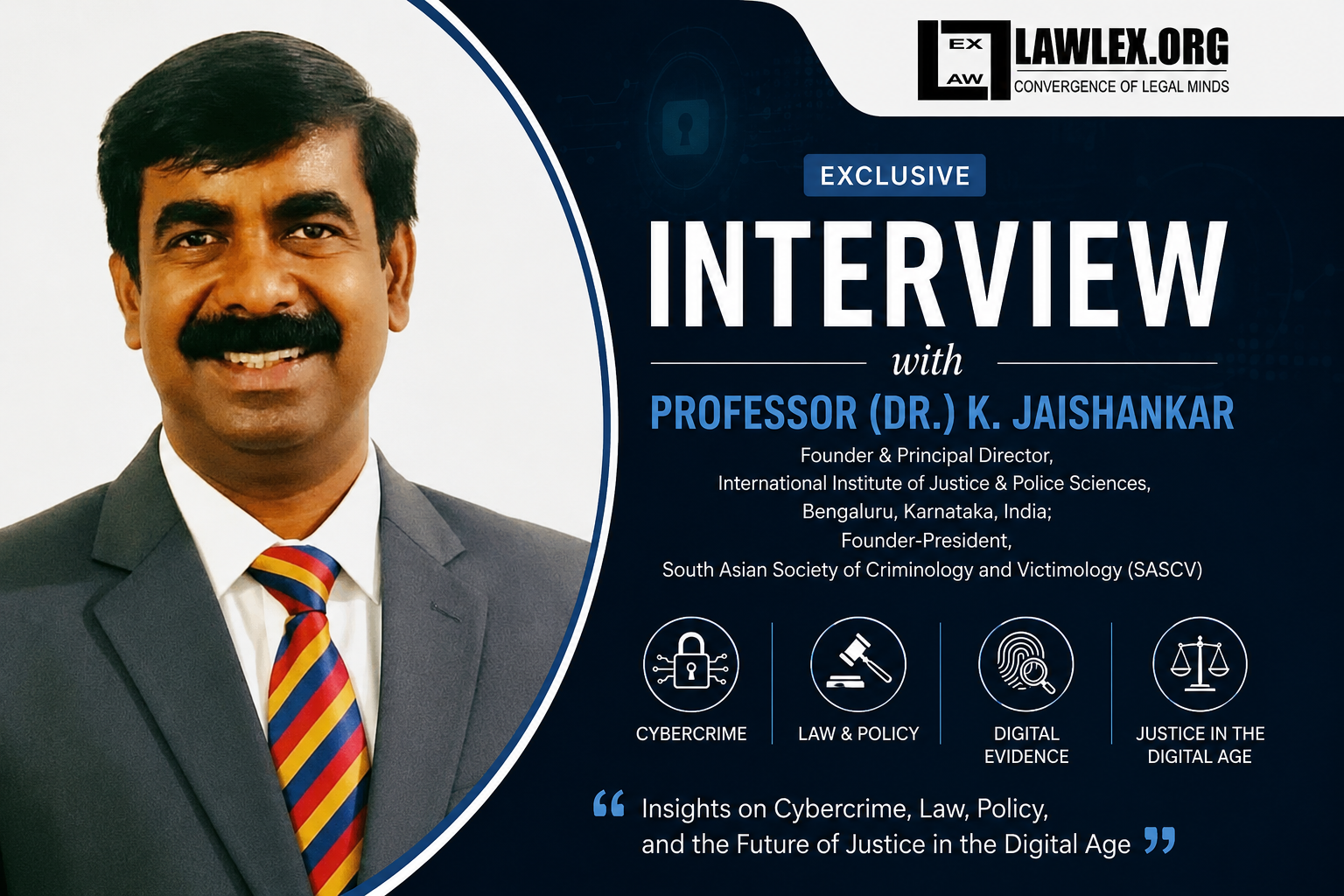
As technology reshapes every aspect of society, it is also transforming the nature of crime. Questions about cyber fraud, digital evidence, AI-enabled offences, and online victimisation have become central to contemporary legal discourse. To explore these challenges, we spoke with Professor (Dr.) K. Jaishankar, founder of Cyber Criminology and one of the world’s leading experts on cybercrime and victimology.
***
- You coined the term “Cyber Criminology” in 2007, nearly two decades ago. How has the law’s understanding of cybercrime evolved since then, and where does it still lag behind the reality on the ground?
When I coined the term Cyber Criminology in 2007, I intended to establish cybercrime as an autonomous field of criminological inquiry rather than merely a technical or legal issue. Over the last two decades, lawmakers and criminal justice agencies have become far more aware of cyber-dependent and cyber-enabled crimes. Digital evidence, transnational investigations, and cyber forensics have become mainstream concerns. However, legislation and judicial processes still largely treat cybercrime as an extension of conventional crime. The pace of technological innovation far exceeds the speed of legal adaptation. The law often remains reactive, while cyber offenders are proactive and highly adaptive. In many jurisdictions, including India, we continue to face challenges relating to attribution, jurisdiction, digital evidence, and victim support.
- India’s IT Act 2000 was amended in 2008, but critics argue it has not kept pace with the sophistication of modern cybercrime. What specific legislative gaps concern you the most today?
The Information Technology Act, 2000, as amended in 2008, was progressive for its time. However, the cyber ecosystem has transformed dramatically since then. My primary concerns are the absence of explicit provisions dealing with AI-enabled fraud, deepfakes, cyberstalking, online coercive control, cryptocurrency-related offences, and large-scale data breaches. There is also a need for stronger procedural mechanisms for digital evidence preservation and greater clarity regarding intermediary liability. Furthermore, cyber victim rights have not been adequately recognized in the legal framework. A comprehensive revision rather than piecemeal amendments may now be necessary.
- With the Digital Personal Data Protection Act 2023 now in force, do you think India finally has a credible framework for cyber victim protection, or is it still largely an industry-facing statute?
The Digital Personal Data Protection Act, 2023, is a significant milestone because it recognizes privacy and data governance concerns. However, I view it primarily as a regulatory framework rather than a victim-centric statute. Its focus is largely on compliance obligations and industry responsibilities. Cyber victim protection requires much more—timely notification mechanisms, psychological support, compensation frameworks, legal aid, and clear avenues for grievance redressal. Therefore, while the Act strengthens data governance, it does not yet constitute a comprehensive cyber victim protection regime.
- Deepfakes, AI-generated fraud, and algorithmic manipulation are emerging threats. Does existing criminal law, in India or globally, have the conceptual vocabulary to even define these as crimes?
Existing criminal law often relies on traditional concepts such as deception, forgery, impersonation, and fraud. While these principles can be stretched to address AI-generated harms, they are not always conceptually adequate. Deepfakes and algorithmic manipulation raise unique questions about authenticity, consent, identity, and cognitive exploitation. In my opinion, legal systems worldwide are still developing the vocabulary necessary to address these emerging forms of criminality. We need conceptual innovations that recognize harms arising from synthetic media and autonomous technologies.
- You founded the field of Cyber Victimology in 2015. In your view, how well does India’s criminal justice system treat cyber victims as witnesses, as parties, or as afterthoughts?
Unfortunately, cyber victims are often treated as afterthoughts. The system focuses predominantly on investigation and prosecution, while the emotional, financial, and social consequences suffered by victims receive inadequate attention. Victims are frequently viewed merely as sources of information rather than stakeholders with rights and needs. Cyber Victimology seeks to change this perspective by emphasizing victim experiences, victim support, and victim resilience. A victim-centric approach must become an integral component of cybercrime governance.
- Your Centre for Cyber Victim Counselling is a rare initiative combining psychology with legal response. Should victim counselling be made a statutory obligation for law enforcement when registering cybercrime FIRs?
Absolutely. Cyber victimization often results in trauma, shame, anxiety, and depression. Many victims experience secondary victimization through insensitive institutional responses. Therefore, counselling should not be regarded as optional but as an essential component of victim assistance. I strongly believe that psychological support and legal guidance should be institutionalized and made available immediately after cybercrime complaints are registered. Such a measure would represent a truly victim-oriented criminal justice approach.
- Therapeutic Criminology, which you founded in 2023, seems to challenge the retributive logic that underlies most penal codes. How do you see it fitting into a legal system like India’s, which is still largely punishment-oriented?
Therapeutic Criminology does not reject accountability; rather, it complements it. Excessive emphasis on punishment alone has often failed to address the underlying causes of offending and victim suffering. Therapeutic Criminology seeks to integrate psychological healing, rehabilitation, and social restoration into the justice process. Even within a punishment-oriented legal system, therapeutic principles can operate alongside conventional sanctions. Justice should not only punish wrongdoing but also facilitate healing and reintegration wherever possible.
- Restorative justice and therapeutic approaches are sometimes seen as “soft” by the legal community. How do you make the case for them within a framework that also demands accountability?
Restorative and therapeutic approaches should not be mistaken for leniency. Accountability remains central. What distinguishes these approaches is that they seek to repair harm and prevent recurrence rather than focusing exclusively on retribution. Empirical evidence from various jurisdictions demonstrates that restorative mechanisms can enhance victim satisfaction, reduce recidivism, and promote social harmony. Justice should be measured not only by the severity of punishment but also by the extent to which it restores individuals and communities.
- You also introduced Political Victimology and Theological Victimology in 2023. These feel especially urgent given global trends from targeted persecution of minorities to politically motivated prosecutions. What practical tools can the legal community draw from these frameworks?
Political Victimology and Theological Victimology seek to understand victimization arising from political structures and religious contexts. These frameworks encourage the legal community to recognize patterns of selective victimization, structural inequalities, hate crimes, and abuses of power. Practically, they offer tools for victim-sensitive legal reforms, human rights monitoring, conflict resolution, and early warning mechanisms. They remind us that victimization is often deeply embedded within social and political systems.
- Your Space Transition Theory explains why people behave differently in cyberspace than in physical space. With courts now treating online statements on par with physical speech for defamation and sedition purposes, do you think the law is applying this equivalence too simplistically?
Space Transition Theory demonstrates that cyberspace possesses characteristics that facilitate behavioural transformations. Factors such as anonymity, dissociation, and fluid identities influence conduct in ways that differ from physical environments. Therefore, equating online and offline behaviour without appreciating these contextual differences may oversimplify complex realities. Legal accountability is necessary, but judicial reasoning should also recognize the distinctive dynamics of cyberspace.
- As an Adjunct Faculty Member at the UN Interregional Crime and Justice Research Institute, how do you assess the coherence of international legal cooperation on cybercrime, especially between countries with very different data sovereignty positions?
I would not comment on this question as I am not a permanent member of UNICRI.
- The Budapest Convention on Cybercrime remains the primary international instrument, but India has not signed it. Is that a strategic gap, and what alternatives exist?
India’s reservations regarding the Budapest Convention stem primarily from concerns about participation in its drafting and issues relating to sovereignty. Whether this constitutes a strategic gap depends on one’s perspective. While the Convention has facilitated international cooperation, alternative approaches are emerging, including broader multilateral initiatives under the United Nations framework. What matters most is not merely membership in a treaty but ensuring effective international collaboration based on equality, trust, and mutual legal assistance.
- You’ve built entirely new academic sub-disciplines, something very few scholars achieve. What does the Indian legal academy, in your view, still fail to produce enough of: theory, empirical research, or policy translation?
All three deserve greater attention, but I would particularly emphasize theory and empirical research. Too often, legal scholarship remains descriptive and doctrinal. Robust theories and evidence-based research are essential for developing effective policies. We also need stronger mechanisms for translating academic knowledge into practical reforms. Legal scholarship should engage with society’s evolving challenges rather than remain confined to traditional boundaries.
- For young lawyers and law students entering the cybercrime and digital law space today, what is the one area of knowledge they most consistently lack?
I believe the greatest gap lies in interdisciplinary understanding. Cybercrime cannot be understood solely through legal doctrine. Lawyers must appreciate criminology, psychology, victimology, sociology, forensic science, data governance, artificial intelligence, and digital technologies. The future belongs to professionals who can bridge disciplines and understand human behaviour in technological environments.
- If you could change one thing about how Indian courts currently handle cybercrime cases — procedurally, evidentially, or attitudinally, what would it be?
I would advocate for a stronger victim-centric and technologically informed judicial culture. Cybercrime cases often suffer from delays, inadequate appreciation of digital evidence, and insufficient understanding of victim harms. Specialized training for judges, dedicated cyber benches, and greater sensitivity toward victims are essential. Ultimately, justice in the digital age must be not only technologically competent but also humane.
***
You can follow Professor (Dr.) K. Jaishankar here- https://www.linkedin.com/in/professorjaishankar/
The interviewer extends sincere gratitude to Professor (Dr.) K. Jaishankar for generously sharing his time, expertise, and valuable insights. His pioneering contributions to the field of Cyber Criminology and his continued efforts in advancing research, policy, and education have significantly shaped contemporary understanding of cybercrime and victimology. The perspectives shared in this interview provide important guidance for scholars, practitioners, policymakers, and students navigating the rapidly evolving digital landscape. It was an honour and privilege to engage in this insightful conversation.
Interview Curated by- Ms. Yashika Paraswani, Managing Editor, LawLex.Org
Who should we interview next? Tell us in the comments below!